
Review · SERBIA
Get Big Picture of Belgrade at its 2,000 years old Fortress
Belgrade’s best viewpoint comes with a complicated past. This private 90-minute walk through Belgrade Fortress and Kalemegdan Park pairs sweeping views of the Sava and Danube with a clear account of Romans, Ottomans, Habsburgs, Nazis, and the Cold War. I especially like the private format, which lets your group ask questions without keeping pace with strangers, and the art historian guide, who brings political arguments and local stories into the walk. The main consideration is pace: 90 minutes goes quickly in a place with 2,000 years of history, so this is a strong introduction rather than a complete fortress visit.
The route is a good fit if you have only a short time in Belgrade or want help making sense of what you are seeing. Guide Igor has earned particular praise for his passion, storytelling, and willingness to discuss Serbia’s past and present, while guides Igor and Ksenija have led some departures. For the best views, schedule the tour near sunset, but check the season carefully because Belgrade’s sunset can range from about 4:30 p.m. in winter to after 7 p.m. in summer.
In This Review
- Five things to know before you book
- Why Belgrade Fortress is the right place to begin
- Roman foundations, medieval walls, and military churches
- The Noon bell and the fortress’s political stories
- Underground spaces and unexpected cultural connections
- Kalemegdan Park and the big river view
- Is $66.01 good value for 90 minutes?
- Who will enjoy this private Belgrade walk?
- My take: book it for context, not just scenery
- FAQ
- How long does the Belgrade Fortress tour last?
- What language is the tour offered in?
- Is this a private tour?
- What is included in the price?
- Where does the tour begin?
- Where does the tour end?
- Can I book the tour for sunset?
- Do I need to be physically fit for the tour?
- What is the cancellation policy?
Five things to know before you book
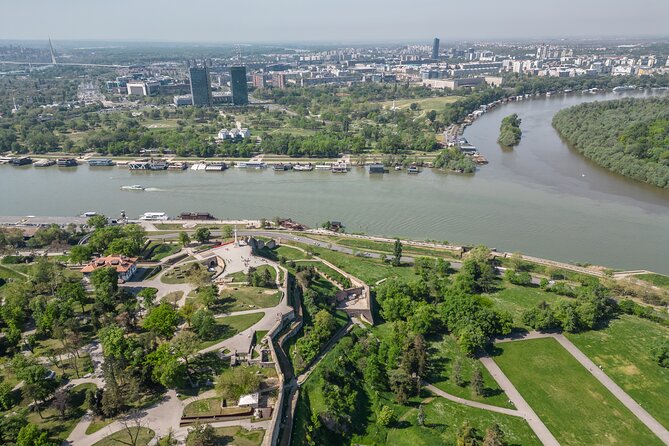
- The views explain Belgrade’s location: From the fortress, you can see the Sava and Danube meet, along with New Belgrade and Zemun.
- The history moves across two millennia: The route connects Roman foundations, medieval walls, Ottoman rule, Habsburg campaigns, Nazi bombing, and Cold War fears.
- It is genuinely private: Your group alone takes part, with space for up to eight people.
- The guide shapes the experience: An art historian leads the walk, with Igor and Ksenija named among the guides associated with the experience.
- Sunset adds atmosphere: Kalemegdan’s open views make late-day scheduling especially appealing for couples and photographers.
- You need moderate fitness: Expect an outdoor walking tour through gates, walls, towers, park paths, and historic areas.
Why Belgrade Fortress is the right place to begin
Belgrade Fortress is not a single castle sitting apart from the city. It is a layered stronghold at the meeting point of two major rivers, a position that made it valuable for trade, defense, and empire. The modern fortress area includes walls, gates, towers, churches, underground spaces, archaeological remains, and a large public park.
That setting gives the tour its main strength. You do not simply hear dates in a room. You move through the same strategic ground that armies fought to control. One wall may point toward the water, another toward the city, and a gate may reveal how the fortress grew and changed over time.
The tour begins at the Art Pavilion Cvijeta Zuzorić at Mali Kalemegdan 1. That is a useful detail to note, because Belgrade has several entrances and open areas around the fortress. The walk ends near the Embassy of France at Pariska 11, placing you close to central Belgrade after the tour.
The private arrangement matters here. A public group can make a historic site feel like a conveyor belt, especially when you want to ask why a certain wall was built or how a political event affected ordinary people. With only your own party, you can pause for questions and follow the subjects that interest you most. The tour is available in English and can be booked for up to eight people.
Other trips worth a look in Belgrade:
- Northern Serbia: Sremski Karlovci and Novi Sad Full-Day Tour from Belgrade
★ 5.0 · 425 reviews - Day Trip from Belgrade: Gems of Eastern Serbia
★ 5.0 · 424 reviews - Belgrade Nightlife Bar Pub Club Crawl with Drinks
★ 5.0 · 277 reviews
Roman foundations, medieval walls, and military churches
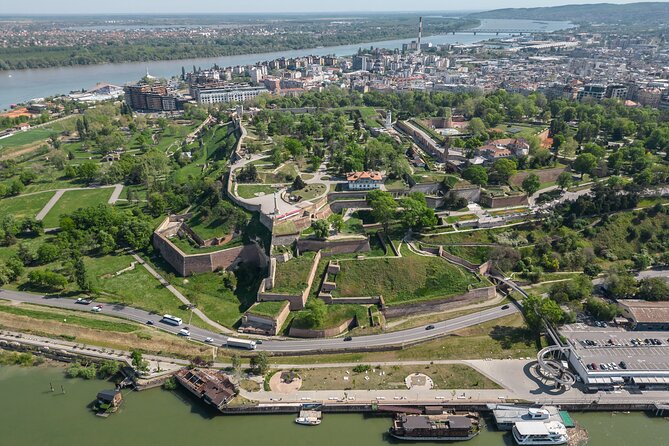
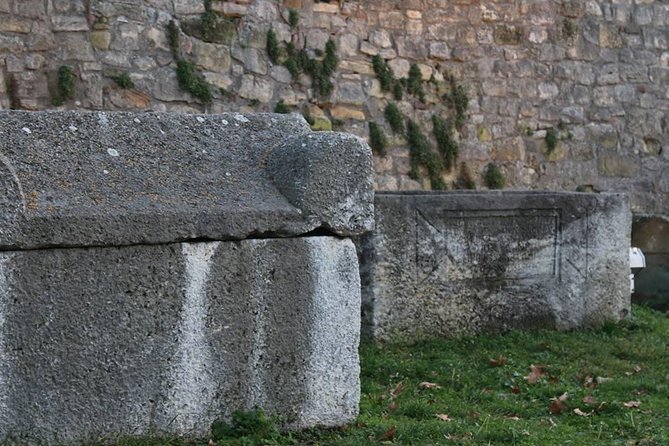
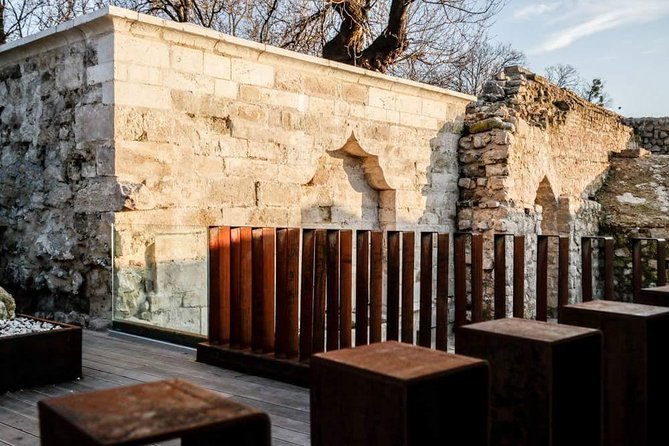
The first part of the walk introduces the physical remains. You can expect to pass through gates and beside walls while the guide explains how the site developed from its Roman beginnings. The route also includes the foundations of a medieval castle and a Roman wall, details that help you see the fortress as an archaeological site rather than just a scenic overlook.
The layers are the point. Belgrade has repeatedly been rebuilt, attacked, occupied, and altered. The guide traces the succession of powers that fought for this piece of earth, water, and sky, moving from the decline of the Roman Empire to Ottoman and Habsburg control, then into the modern political era.
One especially memorable detail is a church built from a former military magazine. That single building connects religion, warfare, and adaptation in a way a list of dates cannot. The fortress contains many such reminders that old structures rarely have only one life.
The route also includes dungeons and towers. Exact access can depend on the conditions of the site and the tour’s timing, so you should think of these as part of the historic setting rather than expect a long underground visit. Still, the underground spaces add an important contrast to the open views above. Belgrade’s story is not only about rulers looking across the rivers. It is also about confinement, storage, defense, and survival.
The Noon bell and the fortress’s political stories
This experience is strongest when it moves beyond standard sightseeing facts. The guide brings in questions that connect Belgrade with wider European history, including why the noon bell in churches across Europe is linked to the fortress.
The story reaches back to the Ottoman siege of Belgrade. The exact explanation is one of the tour’s distinctive historical threads, and it gives the fortress a role far beyond Serbian national history. You are not simply looking at a local wall. You are standing at a point where events affected religious and political life across Europe.
Another unusual question concerns the Ottoman sultan who called the fortress his Contemplation Hill. Details like this give you a sense of how the site was viewed by people on different sides of the conflict. A fortress can be a military objective to one ruler, a spiritual or reflective place to another, and a public park to modern residents.
The guide also tackles difficult modern subjects. You hear what happened when Nazi forces bombed Belgrade in 1941 and how the city faced the threat of a Soviet invasion in the 1950s. Those episodes are important because they show that the fortress is not frozen in medieval time. Its strategic meaning continued into the 20th century.
The experience includes political interpretation as well as military facts. If you enjoy history and politics, you will likely find the discussion especially rewarding. If you prefer a quick walk with only a few easy facts, the amount of context may feel demanding for a 90-minute tour.
Underground spaces and unexpected cultural connections
The fortress has inspired artists as well as generals. One story asks which filmmaker told the press he felt inspired after going underground. The information provided does not identify the filmmaker in advance, so you will need to ask the guide during the walk. That uncertainty is part of the fun, particularly if you enjoy connecting historic places with modern culture.
These stories work best when you treat the tour as a conversation. Igor, in particular, is praised for welcoming questions and even friendly debate. That makes a difference in Belgrade, where history and present-day politics can be closely linked. You are not being handed a single tidy version of the past. You are hearing a local historian’s interpretation and can ask how earlier events still shape the city.
A useful expectation: this is not a museum tour with a large collection of objects and long indoor stops. The main evidence is the site itself, along with the guide’s explanation. You will spend most of the time outdoors, moving between monuments and viewpoints.
Wear shoes suited to walking and bring protection from changing weather. The experience requires moderate physical fitness, and the route includes fortress paths and historic structures rather than a flat indoor floor. Service animals are allowed, and the meeting area is near public transportation.
A completely different kind of day:
- Taxi to/from Belgrade Airport to/from Belgrade City Center
★ 5.0 · 241 reviews - Belgrade Big Tour: Top Attractions and Belgrade Neighborhoods
★ 5.0 · 232 reviews - Along the Danube: Golubac Fortress & Iron Gate Gorge day trip from Belgrade
★ 4.5 · 185 reviews - From Belgrade: Golubac Fortress & Iron Gate Danube Gorge
★ 4.8 · 185 reviews
Kalemegdan Park and the big river view
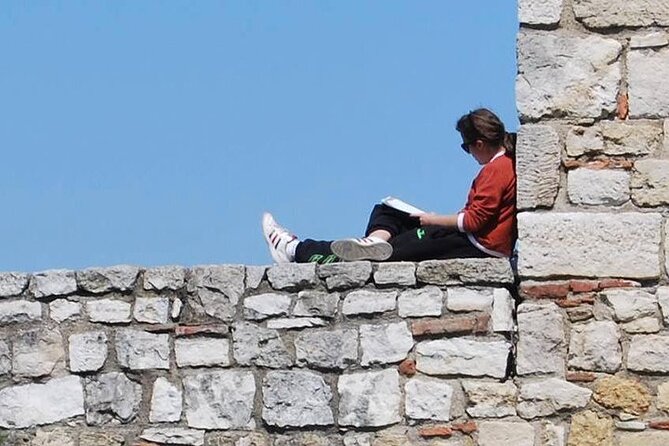
The final part of the experience moves through Kalemegdan Park and returns attention to the view. The park gives the fortress a softer edge, with greenery around the military remains. It is a welcome change after focusing on battles, sieges, and political threats.
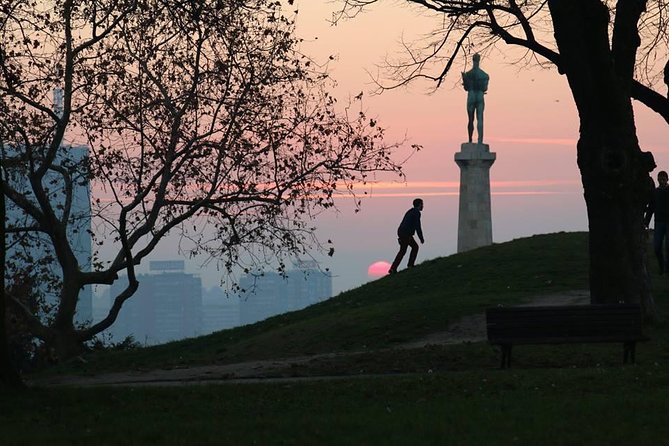
From the high ground, you can look over the Sava and Danube and see where they meet. You also get views toward New Belgrade and Zemun, two parts of the city with very different identities. New Belgrade was built as the capital of Socialist Yugoslavia, while Zemun has a quieter Central European character.
This is more than a photo stop. The view helps you understand Belgrade’s geography and politics. The old fortress occupies the historic core, while New Belgrade spreads across the river in a planned modern district. Zemun adds another urban story, with its own look and connection to the former Habsburg world.
I would schedule the tour late in the day if your dates allow. The provider gives approximate sunset times of 5:30 p.m. in autumn, 4:30 p.m. in winter, around 6 p.m. in April and May, and after 7 p.m. in summer. Sunset timing affects more than photographs. Softer light makes the rivers easier to appreciate, and the open park setting gives the last part of the walk a calm finish.
Morning also has a clear advantage. A morning visit can give you a fresh orientation to the city, and the views may be crisp and bright. One guest particularly enjoyed seeing the fortress and panorama early in the day. Choose sunset for mood, morning for a clear start, and check the exact local sunset time before booking.
Is $66.01 good value for 90 minutes?
At $66.01 per person, this is not the cheapest way to see Belgrade Fortress. The price makes the most sense for a small private group that values personal explanation and flexibility. If eight people share the booking, the per-person value improves considerably. For one or two people, you are paying more for the guide’s attention than for the length of the walk.
Admission is included for the fortress portions, and there are no listed extra charges. Kalemegdan Park itself is free. You are paying mainly for the professional art historian and the private format, not for a long list of paid attractions.
That distinction is important. You can walk around the fortress independently, take in the river views, and enter the park without this tour. The added value is the structure and interpretation: knowing which remains are Roman, understanding how Ottoman and Habsburg struggles shaped the site, and seeing links between medieval events and 20th-century politics.
The tour is also efficient. With only 90 minutes, you can get a strong introduction without giving up half a day. That suits someone on a short city break, a family that does not want a long historical walk, or a small group that wants a local perspective before exploring further on its own.
The trade-off is limited time. You cannot expect every gate, tower, underground room, and historical period to receive equal attention. If you want a very slow archaeological examination, this tour may feel too short. If you want the fortress to make sense quickly, the length is sensible.
Who will enjoy this private Belgrade walk?
I would choose this tour for people who like history with a political edge. The strongest material concerns war, power, religion, occupation, and the way Belgrade has been understood by competing empires. You will get more from it if you enjoy asking questions rather than simply collecting photographs.
It also suits families and small groups. Booking for up to eight people keeps the walk intimate and lets the guide adjust the conversation. Children who like forts, underground spaces, and dramatic stories may enjoy it, though the historical detail could be more demanding for very young children.
Couples should consider a sunset departure. The river confluence and park views give the experience a romantic finish without turning the entire tour into a photo session.
This is less suitable if you need a fully indoor activity, have difficulty with moderate walking, or want a long visit at each monument. The tour is outdoors, and its strength comes from connecting the physical setting with spoken explanation.
The cancellation terms are straightforward: you can receive a full refund if you cancel at least 24 hours before the start time. Changes or cancellations made within 24 hours are not accepted for a refund, and cut-off times follow local time.
My take: book it for context, not just scenery
You should book this tour if you want Belgrade Fortress to become understandable, not merely attractive. The views are excellent, but the guide’s stories give them meaning. The Romans, sultans, Habsburgs, Nazis, and Cold War planners all help explain why this high ground mattered for so long.
I especially like the mix of broad history and odd details: the noon bell connection, the Contemplation Hill story, the church made from a military magazine, and the modern threat of Soviet invasion. Igor’s passionate style and willingness to discuss difficult subjects appear to be a major strength, with Ksenija also associated with the guiding team.
Book it for a private group, a first morning in Belgrade, or a sunset walk when you want both orientation and atmosphere. Skip it if you only need free time in the park or prefer to explore every corner at your own pace. For most people with a serious interest in Belgrade’s past, $66.01 buys a useful framework for the rest of the city.
FAQ
How long does the Belgrade Fortress tour last?
The tour lasts approximately 1 hour and 30 minutes.
What language is the tour offered in?
The tour is offered in English.
Is this a private tour?
Yes. Only your group participates, and the booking can accommodate up to eight people.
What is included in the price?
A professional art historian guide and the private tour are included. Admission is also included for the fortress portions of the experience.
Where does the tour begin?
The meeting point is the Art Pavilion Cvijeta Zuzorić at Mali Kalemegdan 1 in Belgrade, Serbia.
Where does the tour end?
The tour ends at the Embassy of France at Pariska 11, Belgrade 11000, Serbia.
Can I book the tour for sunset?
Yes. Sunset scheduling is recommended for panoramic views and sunset watching. Approximate sunset times range from 4:30 p.m. in winter to after 7 p.m. in summer.
Do I need to be physically fit for the tour?
You should have a moderate level of physical fitness. The experience is an outdoor walking tour through the fortress and Kalemegdan Park.
What is the cancellation policy?
You can cancel at least 24 hours before the start time for a full refund. Cancellations or changes made less than 24 hours before the start time are not accepted for a refund.
Just added in Belgrade
- Private Half Day Serbia Tour Novi Sad and Petrovaradin Fortress★ 5.0 · 3 reviews
- Zasavica Bike Tour★ 5.0 · 1 review
- Private Belgrade Street Art and Adventures Walking Tour★ 5.0 · 4 reviews
- Private Wine Tasting by Party in Belgrade★ 5.0 · 3 reviews
- VIP Reservation Service in Belgrade★ 5.0 · 2 reviews
- Urban & Alternative Belgrade tour★ 5.0 · 4 reviews
- Rakija Tasting for groups in Belgrade★ 5.0 · 1 review
- Wonders of Eastern Serbia a Full Day Tour from Belgrade★ 5.0 · 1 review