
Review · CITY TOURS
Belgrade Sightseeing Half-Day Trip Old and New Belgrade
Belgrade tells its story in layers. This private three-hour tour links the fortress, socialist New Belgrade, grand royal streets, and the immense Saint Sava Temple, giving you a useful first look at a city that can otherwise feel spread out. I especially like the mix of walking and driving, and the way the route reaches places well beyond the old center.
I also like the personal setup. Hotel pickup, a private vehicle, and an English-speaking guide make the morning easy, while guides such as Alexander, Ivan, Vladimir, Milosh, and Stefan have earned praise for clear explanations and flexible pacing. The main drawback is time: several important places get only a short stop, and one account found the experience closer to two hours than the advertised three.
In This Review
- Key points to know before booking
- Belgrade in three hours: what this tour is really for
- Kalemegdan and the fortress: Belgrade’s essential first stop
- Pobednik and the Upper Town: monuments, gates, and river views
- New Belgrade: a sharp turn into socialist modernism
- Dedinje and Topčider Hill: mansions, politics, and football
- Saint Sava Temple: the tour’s grand interior visit
- Nemanjina Street, royal palaces, and the center
- Republic Square: a practical ending in the heart of town
- Private transport, pace, and what is included
- Who should book this Belgrade overview?
- Final call: a good first morning, with one time caveat
- FAQ
- How long does the Belgrade sightseeing tour last?
- Is hotel pickup included?
- Is pickup from Belgrade Airport available?
- What transport is used?
- Is this a private tour?
- Is the tour offered in English?
- Is entry to Saint Sava Temple included?
- Can I cancel for a full refund?
Key points to know before booking
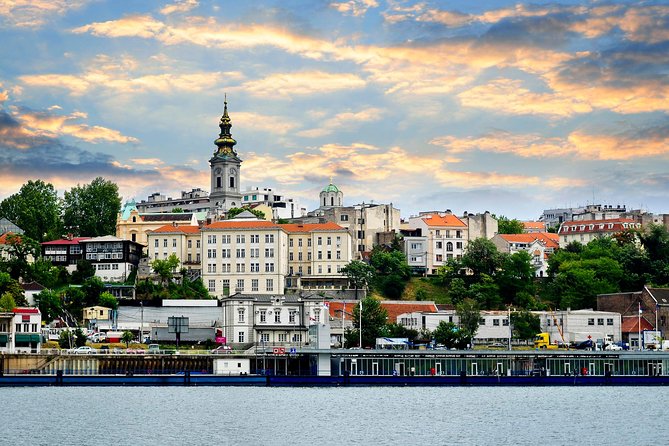
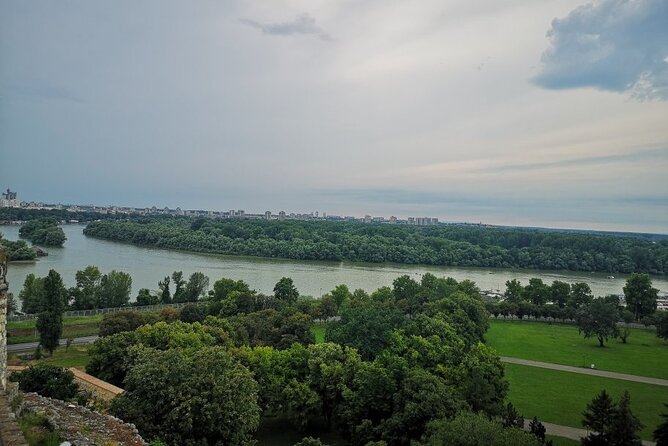
- The fortress walk gives you Belgrade’s best river view, where the Sava meets the Danube from the Upper Town.
- New Belgrade adds a sharp change of mood, with postwar socialist architecture, brutalist towers, business buildings, and the Sava Center.
- The private format keeps the tour flexible, useful for families, older visitors, or anyone with a special interest.
- Saint Sava Temple is the major interior visit, with admission included and about 30 minutes set aside.
- Dedinje adds 20th-century politics and football, from Tito’s former memorial complex to the rival Red Star and Partizan stadiums.
- The route suits a short stay, but it is a city overview rather than a slow, detailed exploration.
Belgrade in three hours: what this tour is really for
At $150.85 per person, this is not the cheapest way to see Belgrade. The price makes more sense if you are booking privately, traveling with family or friends, arriving on a short stop, or wanting door-to-door transport without working out the city’s geography yourself.
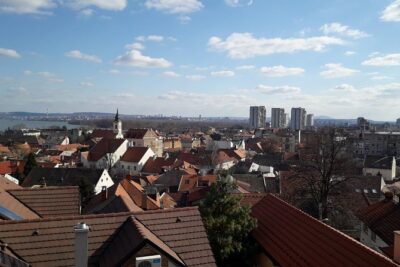
The tour covers a lot of ground. You walk through Kalemegdan and the fortress, then return to the vehicle for New Belgrade, Dedinje, Vračar, central government streets, and Republic Square. That range is the main value. You see how Belgrade shifts from ancient defensive walls to socialist concrete, royal-era avenues, leafy mansions, and modern sports venues.
I would not choose this as your only activity if you have several days in the city and prefer long museum visits or unhurried neighborhood walks. I would choose it at the beginning of a stay, when you want a map in your head and a guide to explain why the city looks the way it does.
The average booking point is 51 days ahead, which suggests that visitors often arrange it as part of a planned Serbia trip. Still, the private format means it can work especially well for a last-minute short visit if a suitable time is available.
More city tours in Belgrade:
- Taxi to/from Belgrade Airport to/from Belgrade City Center
★ 5.0 · 241 reviews - Belgrade Underground Tour w/ Sparkling Wine Along the River
★ 5.0 · 151 reviews - Belgrade Private City Tour
★ 5.0 · 41 reviews
Kalemegdan and the fortress: Belgrade’s essential first stop
Your guide picks you up from your hotel, Airbnb, pension, or the port, then takes you to Kalemegdan Park. If you are staying within five kilometers of Republic Square, pickup and return are free. From the airport, pickup can be arranged for a €15 supplement.
Kalemegdan is the city center’s oldest and largest park, but the fortress is the real anchor. The walking section begins at Leopold’s Gate and moves through layers of Belgrade’s past. You pass the remains of the Roman castrum of Singidunum, medieval walls, Zindan Gate, Despot’s Gate, and Jakšića Tower.
That sequence is useful because you are not just looking at isolated stones. You can see how Roman foundations, medieval defenses, and later military structures were built over one another. Belgrade’s position at the meeting of major rivers made it valuable, but also exposed it to repeated conflict. The fortress makes that geography plain.
The route includes the Chapel of Saint Petka and Ružica Church, also known as the Church of the Virgin Mary. These are small Orthodox churches inside the fortress area, and they provide a quieter counterpoint to the broad military grounds.
Allow for uneven surfaces and a moderate level of walking fitness. The official walking time for the fortress portion is about 30 minutes, but the larger issue is not distance. It is the mix of stone paths, steps, open ground, and time spent standing while the guide explains the site.
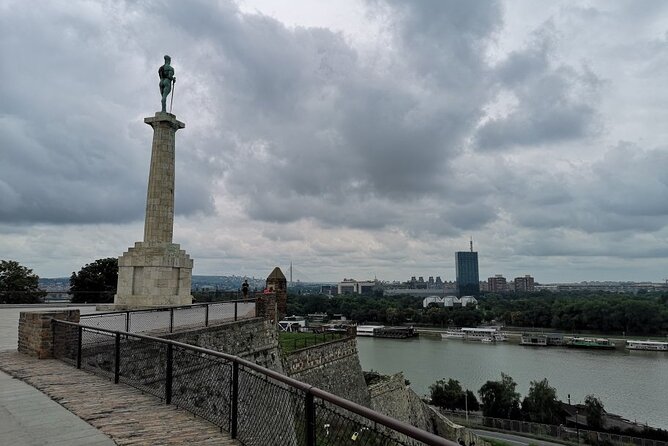
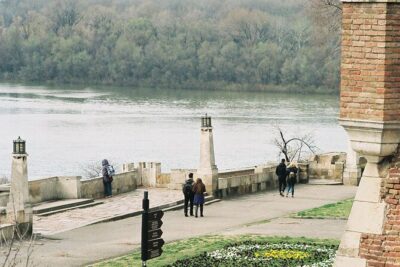
The reward comes in the Upper Town. From here, you get the famous view of the Sava and Danube meeting. It is one of the clearest ways to understand Belgrade’s position, and it gives the tour a strong opening image.
Pobednik and the Upper Town: monuments, gates, and river views
The walk continues to Pobednik, the Victor monument by Ivan Meštrović. The tall figure has become one of Belgrade’s best-known symbols, and its position makes it easy to connect the monument with the rivers and the fortress walls.
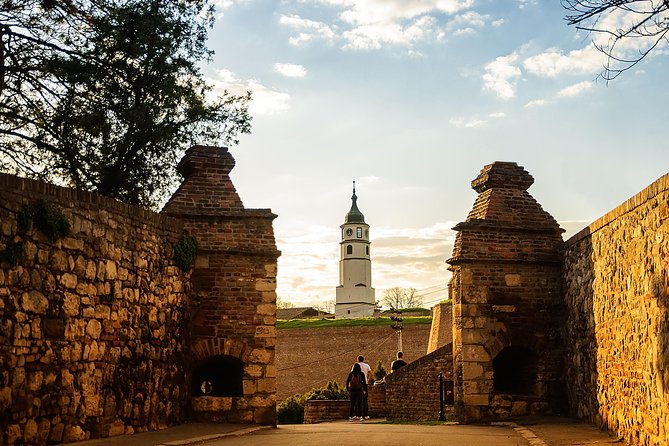
You also pass the Roman Well, King’s Gate, the Sava Promenade, the Damat Ali Pasha Tomb, the Clock Gate, and the Clock Tower. The Military Museum and Istanbul Gate complete this part of the fortress route before you return to Kalemegdan Park and the vehicle.
This is a brisk walk, not a full fortress tour. You will hear about many landmarks, but you should not expect to enter every building or spend long periods at each one. That is a fair trade for the wider route, though anyone who loves military architecture may want to return independently for more time.
A bottle of water is provided for each person. That small detail matters in warm weather, since some portions of the fortress are exposed. One guide also adjusted the pace for a visitor with a bad knee, while another sought shaded areas during a very hot day. Your experience depends on the guide, but the private arrangement gives you a better chance of asking for pauses.
New Belgrade: a sharp turn into socialist modernism
After the fortress, the vehicle takes you across the river to New Belgrade. This is where the tour becomes more unusual than a standard old-town circuit.
New Belgrade was built after World War II during the socialist period. Its broad planning and large concrete buildings offer a very different view of the city. You see the former Central Committee of the Communist Party, the Federal Executive Council, also called the Palace of Federation, and Genex Tower, known as the Western Gate of Belgrade.
The route also passes Sava Center, one of the major congress halls in this part of Europe, along with newer business buildings. The contrast between older brutalist forms and recent commercial architecture gives you a quick lesson in how Belgrade changed after the war and after the breakup of Yugoslavia.
You do not need to be an architecture specialist to appreciate this section. The value is visual contrast. Within a short drive, the city moves from fortress walls and Orthodox churches to huge concrete blocks, towers, roads, and newer glass offices.
New Belgrade’s architecture received international attention through a Museum of Modern Art exhibition called Toward a Concrete Utopia. That detail helps explain why these buildings are not simply eyesores to be passed on the way elsewhere. They reflect a distinct period and planning idea.
The route continues past the restaurant Novak, associated with tennis player Novak Đoković’s family, and Belgrade Arena, the city’s major sports venue. These stops are brief, but they connect the built city with modern Serbian public life.
This portion is almost entirely viewed from the vehicle. If you want to photograph specific buildings, tell your guide early. The tour is designed to show you the area efficiently, not to provide an architectural walking tour.
A completely different kind of day:
- Northern Serbia: Sremski Karlovci and Novi Sad Full-Day Tour from Belgrade
★ 5.0 · 425 reviews - Day Trip from Belgrade: Gems of Eastern Serbia
★ 5.0 · 424 reviews - Belgrade Nightlife Bar Pub Club Crawl with Drinks
★ 5.0 · 277 reviews - Belgrade Big Tour: Top Attractions and Belgrade Neighborhoods
★ 5.0 · 232 reviews
Dedinje and Topčider Hill: mansions, politics, and football
After crossing the Gazela Bridge, you head toward Dedinje, one of Belgrade’s most expensive residential districts. The area’s greenery and large homes provide another change of pace from New Belgrade’s concrete scale.
Your guide explains the background of selected properties and what happened around them during Serbia’s turbulent 20th century. This is one of the more valuable interpretive parts of the ride because the district is not simply a collection of attractive houses. Its buildings are tied to power, wealth, government, and political change.
Football fans get an extra reward here. Rajko Mitić Stadium, home of Red Star Belgrade, is identified as the country’s largest football stadium. Partizan Belgrade’s stadium sits across a small hill, and the rivalry between the clubs has lasted for more than 70 years.
You will not be attending a match or taking a stadium tour. Instead, you get the context while passing the venues. For many visitors, this is enough to understand that football is part of Belgrade’s civic identity, not just an evening activity.
The Museum of Yugoslavia and House of Flowers are also included in the drive. The House of Flowers is the resting place of Josip Broz Tito, leader of the second Yugoslavia. The tour gives you the setting and political background, but entrance to the museum is not listed among the included admissions.
That distinction is important. If Tito and Yugoslav history are central interests for you, plan a separate visit when you can give the museum proper time. On this tour, the stop is mainly an introduction.
Saint Sava Temple: the tour’s grand interior visit
From Dedinje, the vehicle continues to Vračar and the Temple of Saint Sava. This is the tour’s most imposing religious landmark and the principal included interior visit.
Construction began in the 1930s at the place where Ottoman forces burned the relics of Saint Sava. Saint Sava founded and became the first archbishop of the independent Serbian Orthodox Church, and he remains one of the most important figures in Serbian history.
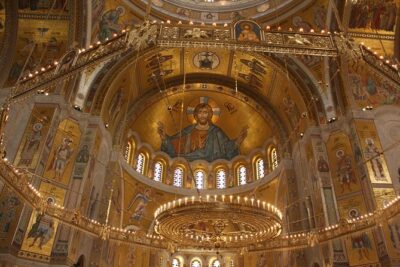
The building follows the Serbian-Byzantine style. Its floor area covers about 3,500 square meters, with another 1,500 square meters in three galleries on the first level. The dome reaches 70 meters, and the gilded cross adds another 12 meters, making the total height 82 meters.
Those figures help explain why the temple is visible from many parts of Belgrade. But measurements are not the main reason to visit. Inside, the scale gives the stop a strong sense of place, while the decorated crypt beneath the church adds a more intimate element.
About 30 minutes is allocated here. That is enough for an introduction and photographs, but not enough for a slow inspection of every detail. Admission is included, so you do not need to budget an extra entry fee.
The temple can be a busy stop in a larger city itinerary, so I appreciate having a guide explain its meaning rather than simply dropping you outside. If your group has a religious, architectural, or historical interest, use the private format to ask for more explanation.
Nemanjina Street, royal palaces, and the center
Once you leave the temple, you return to the vehicle and pass through Slavija Square into Nemanjina Street. This area contains major government buildings, including the Government Building, Ministry of Foreign Affairs, General Staff of the Serbian Army, Ministry of Railways, Ministry of Finance, and the State Court.
The street also gives you examples of Belgrade’s prewar architecture. You see these buildings from the road, so this is another interpretation-heavy section. The guide’s narration matters more here than the chance to stop and enter.
Kralja Milana Street brings you past the Old and New Royal Palaces and toward Nikola Pašić Square. A short stop in front of the National Assembly of the Republic of Serbia allows time for photographs. The tour also connects the palaces with the two dynasties that ruled Serbia in the 19th and 20th centuries.
This is where a good guide can turn a drive into a coherent story. Alexander, in particular, received praise for explaining Belgrade and Serbian history in clear English, while other guides were described as friendly, attentive, and willing to answer questions. No particular guide is guaranteed, but the repeated strength of the guiding is a major reason to consider the tour.
At Terazije Square, you see the 19th-century white stone fountain and the Moskva Hotel, one of the city’s best-known historic buildings. The stop is short, but it places you on one of Belgrade’s central arteries before the final walk.
Republic Square: a practical ending in the heart of town
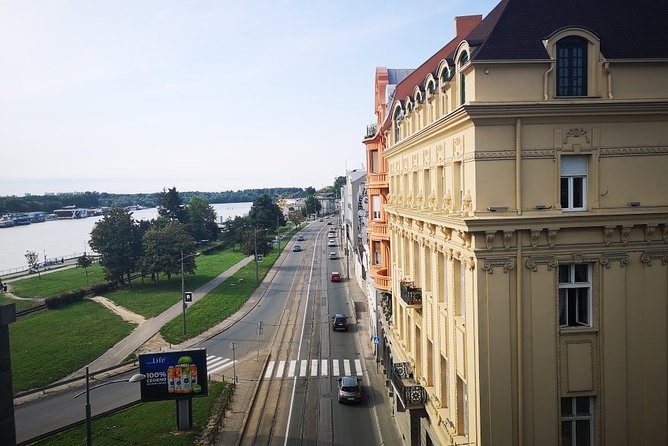
The tour ends at Republic Square, Belgrade’s central meeting point. The National Museum and National Theatre face the square, and the guide explains the importance of Prince Mihailo in modern Serbian history.
Ending here works well. You are close to major central streets and cultural buildings, rather than being returned to an outlying sight. You can continue exploring on foot, find lunch, or use the location as your starting point for a separate old-town visit.
The official time at Republic Square is about 15 minutes. Combined with the short Parliament stop and the 30-minute temple and fortress sections, the schedule is tightly packed. Traffic can also affect the amount of time available, especially during a citywide event or busy period.
One practical warning: the advertised duration is approximately three hours, but one account found the actual tour closer to two hours. That may reflect traffic, pacing, or the specific route on the day. If you are booking this around a flight, allow extra time and confirm the expected finish with the operator.
Private transport, pace, and what is included
For groups of one to three people, transport is by private sedan. Groups of four to seven use an air-conditioned minivan. Fuel and parking fees are included, as are hotel pickup and drop-off within the stated central zone.
The private format is the tour’s clearest practical advantage. You do not wait for strangers, and only your group participates. Guides have adjusted the route for a bad knee, a parent who could not walk far, children aged seven and ten, and visitors with specific interests.
That does not mean the tour is fully accessible. A moderate physical fitness level is expected, and the fortress involves walking on historic surfaces. Service animals are allowed, and the route is near public transportation, but the supplied details do not promise wheelchair access.
The start time is 9:30 am. Pickup is free within five kilometers of Republic Square. A €10 supplement applies for addresses more than five but less than ten kilometers from the center, and airport pickup costs €15. For a location farther than ten kilometers from Republic Square, contact the provider before booking.
The guide speaks English, and a bottle of water is supplied per person. Tips are optional. Children receive the child rate only when sharing with two paying adults.
Who should book this Belgrade overview?
I would recommend it most strongly to:
- First-time visitors who want the city’s main areas explained in one morning
- People on a layover or short stay
- Families who prefer a private vehicle and adaptable pacing
- Visitors who want both historic Belgrade and socialist-era New Belgrade
- Anyone who wants a guide before exploring independently
- Travelers with limited walking endurance who can benefit from vehicle transfers between stops
I would be more cautious if you want extended time inside museums, a slow architectural study, or a long walk through the fortress. The tour gives you a broad introduction, but it cannot provide depth at every stop in three hours.
The strongest part is the guide-led context. Multiple experiences singled out the guides’ English, patience, local knowledge, and ability to answer questions without overwhelming the group. Alexander was praised several times, while Ivan, Vladimir, Milosh, and Stefan were also described as personable and well prepared.
The overall rating is 4.7 from 71 ratings, with 99 percent recommending the experience. That matches the tour’s purpose: it is an efficient, friendly orientation rather than a full historical course.
Final call: a good first morning, with one time caveat
Book this tour if you want Belgrade explained quickly and comfortably, especially if you are short on time or staying outside the center. The fortress and river junction give you the essential setting, Saint Sava Temple supplies the visual high point, and New Belgrade and Dedinje show sides of the city many old-town walks skip.
At $150.85 per person, the value depends on group size. A solo visitor pays a substantial amount for a private overview, while a small group may find the comfort, transport, and personal attention worthwhile. I would confirm the expected duration and pickup point before paying, then use the tour to decide which places deserve a return visit.
FAQ
How long does the Belgrade sightseeing tour last?
The tour lasts approximately three hours, beginning at 9:30 am. The supplied details note that one experience lasted closer to two hours, so you should confirm the expected timing if you have a tight schedule.
Is hotel pickup included?
Yes. Free pickup and drop-off are available from hotels, Airbnbs, pensions, and the Belgrade port within five kilometers of Republic Square.
Is pickup from Belgrade Airport available?
Yes. Airport pickup is available for a €15 supplement.
What transport is used?
Groups of one to three people use a private sedan. Groups of four to seven use an air-conditioned minivan.
Is this a private tour?
Yes. Only your group participates in the activity.
Is the tour offered in English?
Yes. The experience includes an English-speaking professional tour guide.
Is entry to Saint Sava Temple included?
Yes. The entrance fee to Saint Sava Temple is included in the price.
Can I cancel for a full refund?
Yes, if you cancel at least 24 hours before the experience start time. Cancellations or changes made less than 24 hours before the start are not refunded.
Just added in Belgrade
- Private Half Day Serbia Tour Novi Sad and Petrovaradin Fortress★ 5.0 · 3 reviews
- Zasavica Bike Tour★ 5.0 · 1 review
- Private Belgrade Street Art and Adventures Walking Tour★ 5.0 · 4 reviews
- Private Wine Tasting by Party in Belgrade★ 5.0 · 3 reviews
- VIP Reservation Service in Belgrade★ 5.0 · 2 reviews
- Wonders of Eastern Serbia a Full Day Tour from Belgrade★ 5.0 · 1 review
- Urban & Alternative Belgrade tour★ 5.0 · 4 reviews
- Rakija Tasting for groups in Belgrade★ 5.0 · 1 review
City Tours, compared.

Taxi to/from Belgrade Airport to/from Belgrade City Center
Read our review →
Belgrade Underground Tour w/ Sparkling Wine Along the River
Read our review →
Half-Day Sightseeing and Walking Tour of Belgrade City
Read our review →
2 hours / Sightseeing Boat cruise Drinks Included
Read our review →Browse the lists this tour appears in