Review · 1-DAY TOURS
Private Day Trip to Timisoara from Belgrade
Start with a cross-border city break. This private day trip links Belgrade with Timisoara, Romania, a compact city of grand squares, Baroque churches, Art Nouveau façades, and a powerful 1989 revolution story. I like the door-to-door pickup and the chance to combine a guided introduction with free time to explore on your own.
I also like the private car or minivan, especially for a journey that takes about 2.5 to nearly 3 hours each way. Guides such as Uros, Drazen, Konstantin, Milos, Michael, and Stefan have been praised for their warmth, safe driving, and clear explanations. The main drawback is simple: a lot of the day is spent on the road, so this works best if Timisoara matters enough to justify a long day.
In This Review
- Key points to know before booking
- Why Timisoara makes sense from Belgrade
- Leaving Belgrade at 8:00 am
- First impressions at the Orthodox Cathedral
- Victory Square and the city’s public stage
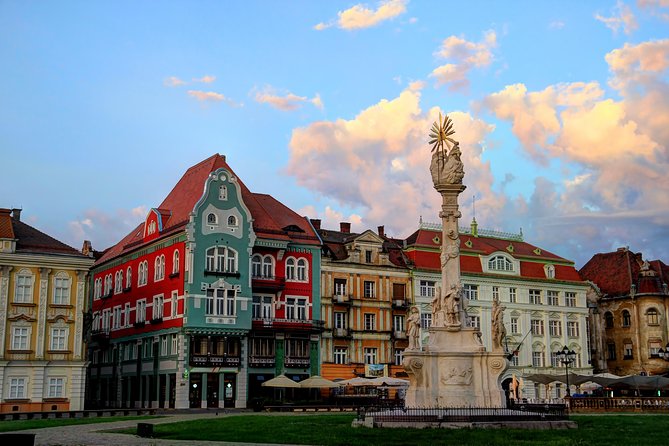
- Liberty Square and the city’s mixed identities
- Union Square and two churches facing each other
- The Serbian Orthodox Cathedral and Roman Catholic Cathedral
- The Memorialul Revolutiei and December 1989
- Free time for lunch, shopping, and your own pace
- The value of $226.85 per person
- What the guides add to the day
- Timing, comfort, and who should book
- Should you book this Timisoara day trip?
- FAQ
- How long is the private day trip from Belgrade to Timisoara?
- What time does pickup begin?
- Where can free pickup be arranged in Belgrade?
- Can I start the tour at Belgrade airport?
- What vehicle is used?
- Is lunch included in the price?
- Is the Memorialul Revolutiei entrance included?
- Is the tour private and offered in English?
Key points to know before booking
- A true private outing: Only your group takes part, with a private sedan for one to three people or an air-conditioned minivan for four to seven.
- Timisoara’s best central sights: The route covers Victory Square, Liberty Square, Union Square, the Orthodox Cathedral, and the city’s major Roman Catholic and Serbian Orthodox churches.
- A serious look at 1989: The Memorialul Revolutiei explains the anti-communist uprising that began in Timisoara through photos, documents, posters, and an English-subtitled film.
- Free time matters: After the walking tour and museum, you can shop, eat Romanian food, take photographs, or simply wander without a guide beside you.
- Good regional context: The drive offers a useful introduction to Serbia, Romania, and the Banat region, rather than treating Timisoara as an isolated postcard stop.
- Plan for a long day: The tour starts at 8:00 am and lasts about 10 hours, with the exact feel of the day shaped by traffic, border formalities, weather, and your pace.
Why Timisoara makes sense from Belgrade
Belgrade and Timisoara are close enough to connect in a day, but the trip still takes commitment. The drive is listed at about 2.5 hours in each direction, while some journeys have taken closer to three hours. That means roughly half the day may be spent in the vehicle.
I think the reward is the change in character between the two cities. Belgrade gives you Serbia’s capital energy and Ottoman, Austro-Hungarian, and Yugoslav layers. Timisoara offers a more compact center shaped by Baroque planning, Central European architecture, and a striking mix of Romanian, Serbian, Catholic, and other cultural influences.
The private format helps here. You are not waiting for a large group, and the driver can explain the countryside and regional connections as you go. Several guides, including Uros, Radenko, Alex, Vladimir, and Konstantin, have been praised for making the drive feel shorter with conversation and background on both countries.
A few more options to weigh up in Belgrade
- Private Red Star-Partizan Stadium Tour in Belgrade
★ 5.0 · 72 reviews - Belgrade Private City Tour
★ 5.0 · 41 reviews - Private Transfer
★ 5.0 · 40 reviews
Leaving Belgrade at 8:00 am
Pickup is offered from hotels, Airbnb properties, pensions within 10 kilometers of Republic Square, and the Belgrade port. Airport pickup is possible for an extra 15 EUR. The standard start time is 8:00 am, which is sensible for a city this far away.
Your transport depends on group size. One to three people travel in a private sedan, while four to seven use an air-conditioned minivan. Fuel, parking, and road tolls are covered, and each person receives a bottle of water.
The practical advantage is not luxury for its own sake. It is control. You can settle into one vehicle, leave your hotel without finding a meeting point, and return directly to your accommodation at the end of a long day.
You should still bring your passport and allow room in your schedule for the border. The tour crosses from Serbia into Romania, and the drive includes customs formalities. One guide was specifically praised for handling the crossing without trouble, but no cross-border trip can promise a fixed journey time.
First impressions at the Orthodox Cathedral
The walking tour begins at Timisoara Orthodox Cathedral, a large late-1930s building in an eclectic neo-Moldavian style. Its design brings together Byzantine, Gothic, Ottoman, and Renaissance influences, so it is a useful first lesson in the city’s mixed cultural setting.
Inside, look for fragments of an 18th-century Baroque altar. The basement contains religious objects, rare books, icons, and paintings. These details make the cathedral more than a quick exterior photograph.
The steps outside carry a darker clue. Bullet marks remain from the December 1989 uprising that began in Timisoara. Your guide can connect those marks to the events later explained at the revolution memorial, giving the day a clear thread rather than a string of unrelated buildings.
The planned stop is about 15 minutes. That is enough for an introduction and photographs, but not a long examination of every religious object. If the cathedral is especially important to you, ask your guide how much time is possible before moving on.
Victory Square and the city’s public stage
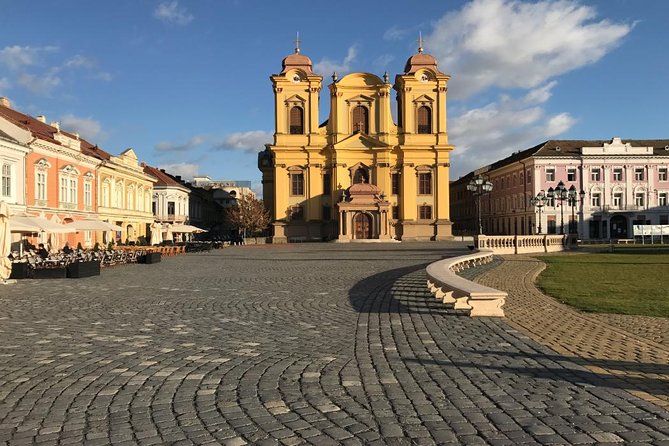
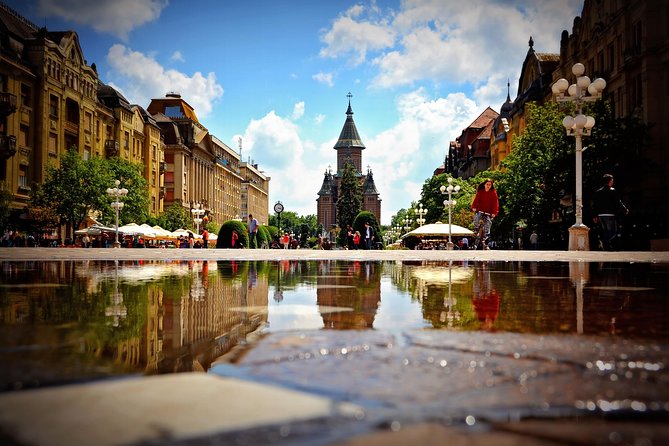
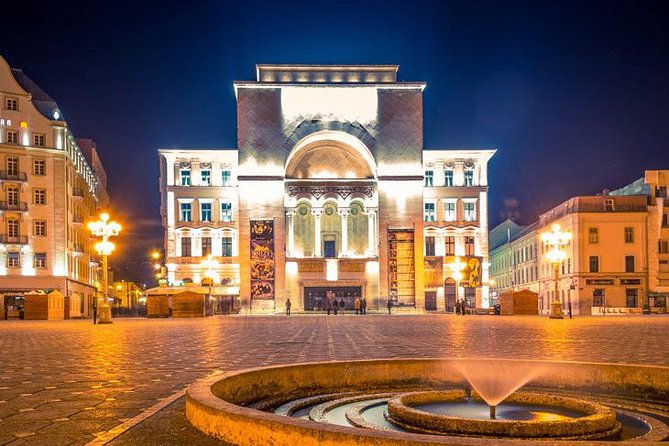
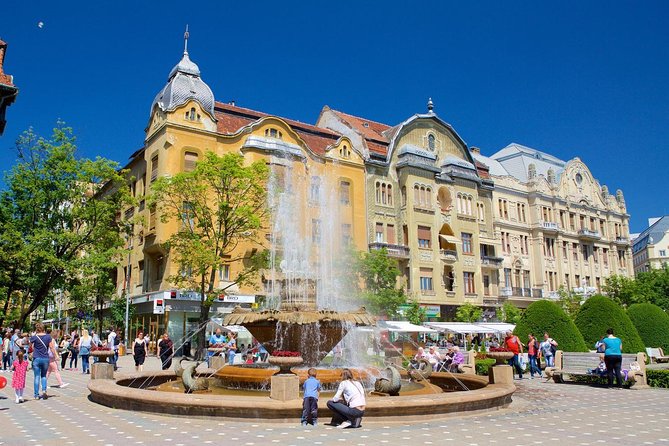
From the cathedral, the route continues to Piata Victoriei, also called Victory Square or Opera Square. Laid out in 1906, it is the city’s grandest public space on this walk and a good place to see the contrast between formal architecture and everyday city life.
The surrounding 19th-century buildings now hold bookshops, galleries, cafés, and restaurants. The square also includes theaters, a museum, a monument to King Ferdinand, an old artesian well, and a Capitoline she-wolf presented by Rome.
The memorial to the victims of the 1989 revolution gives the square added weight. It is not just a handsome civic space. It was a stage for political change, and your guide can help explain why Timisoara occupies such an important place in Romania’s modern story.
The scheduled visit lasts about 20 minutes. That is enough to understand the layout and take photographs, though the cafés and façades may tempt you to linger. You will have free time later, so you do not need to force every photograph into this first pass.
A completely different kind of day:
- Northern Serbia: Sremski Karlovci and Novi Sad Full-Day Tour from Belgrade
★ 5.0 · 425 reviews - Day Trip from Belgrade: Gems of Eastern Serbia
★ 5.0 · 424 reviews - Belgrade Nightlife Bar Pub Club Crawl with Drinks
★ 5.0 · 277 reviews - Taxi to/from Belgrade Airport to/from Belgrade City Center
★ 5.0 · 241 reviews
Liberty Square and the city’s mixed identities
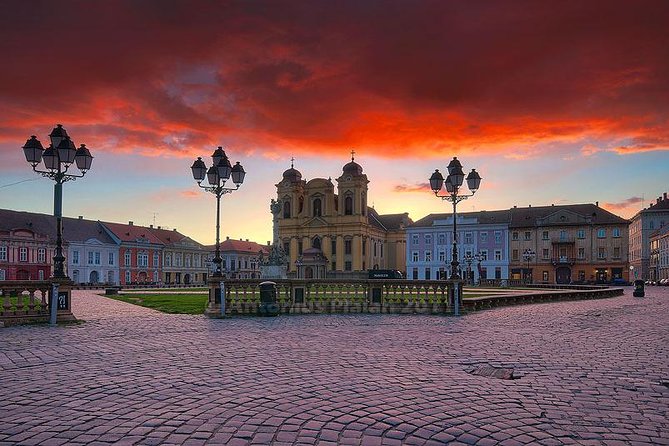
Libertatii Square is smaller in scale but strong on historical detail. The Old City Hall includes a Turkish inscription, a reminder that Timisoara’s past cannot be reduced to one national or religious identity.
The square is bordered by important buildings, including the Casino Military Museum, the old town hall, and the Foreign Ministry. At its center is the Sf Ioan Nepomuk Monument, erected in 1756 in memory of those who died during the plague epidemic of 1738.
This is one of the places where a guide adds real value. Without explanation, you may notice a monument and a collection of old façades. With context, the square becomes evidence of changing empires, religions, and civic authorities.
The stop lasts about 15 minutes. It is brief, but the central area is compact, and the walking route keeps the main sights close together.
Union Square and two churches facing each other
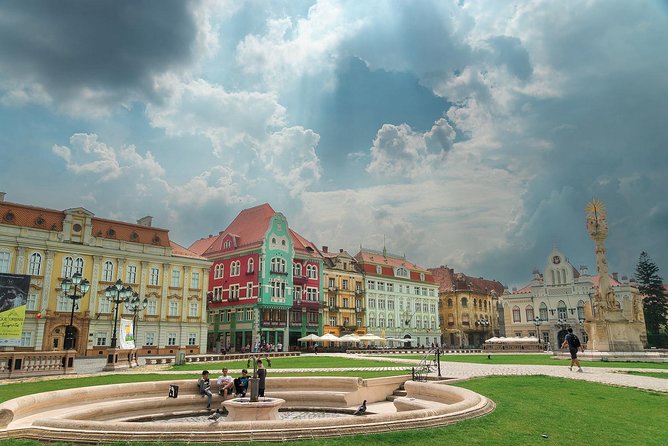
Unirii Square, or Union Square, is the oldest square on the route. Its architecture feels older and more formal than Victory Square, with imposing 18th and 19th-century buildings enclosing the space.
Two churches dominate the scene: the Roman Catholic Cathedral of St. George and the Serbian Orthodox Cathedral. They face each other across the square, a memorable visual expression of the city’s shared religious and cultural setting.
The square was once known as Lasonczy Market, named for Stefan Lasonchy, a 16th-century commander who defended the city against the Turks. Its later name, Union Square, suits the meeting of architectural traditions around it.
You have about 20 minutes here. That gives you time to appreciate the whole square, not just one façade. I would use this stop for wide photographs, then return to details such as the churches, residences, and decorative façades during your independent time.
The Serbian Orthodox Cathedral and Roman Catholic Cathedral
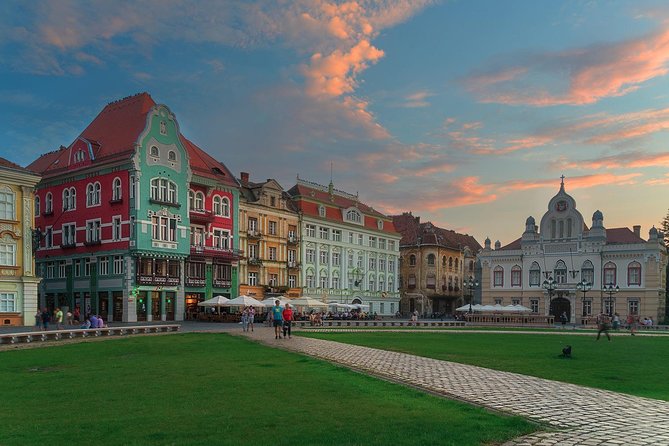
The Serbian Orthodox Episcopal Church was built between 1745 and 1748 in the Baroque style. Its façade contrasts with the nearby Bishop’s Residence, and the pair reflect the long Serbian presence in the Banat region.
That connection will feel especially relevant when you have just arrived from Belgrade. Timisoara is close to the Serbian border, and the city’s Serbian heritage is visible in its religious buildings, not merely mentioned in a museum label.
The Roman Catholic Cathedral of St. George has an equally strong architectural story. Construction began in 1736 and took 18 years. Viennese architect Emanuel Fisher von Erlach designed the project, while local architects Theodor Kostka and Alexander Steinlein continued the work after von Erlach died in 1742.
Inside, the main altar painting of St. George is attributed to Michelangelo Unterberger. The organ was made by Austrian craftsman Carl Leopold Wegenstein. The scheduled route treats the cathedral as another important sight, so ask about interior access and available time if you want a closer look.
These buildings are why the guided walk works better than a simple transfer to Timisoara. A driver can bring you to the square, but the story connecting Vienna, Serbia, Romania, Catholic communities, and Orthodox communities is much easier to grasp with a local guide.
The Memorialul Revolutiei and December 1989
The final formal stop is Memorialul Revolutiei, dedicated to the anti-communist revolution that began in Timisoara in December 1989. The museum includes documents, posters, photographs, and a roughly 20-minute film with English subtitles.
The film is not suitable for young children. The material deals with a painful period, so this is not a light museum visit. For adults interested in recent European history, it gives the day its strongest sense of purpose.
Admission is included, and the planned stop is 30 minutes. That is enough to see the main material, but it may feel short if you read every panel. One visitor arranged extra museum time with the guide and was grateful for the chance to examine more of the exhibits.
That flexibility is worth requesting. The museum is a short walk from the main squares, and the official schedule leaves limited time. If the revolution is your main reason for visiting Timisoara, tell your guide early in the day.
Free time for lunch, shopping, and your own pace
After the guided sights and museum, you have time to explore independently. This is an important part of the experience because the formal walk moves quickly from one landmark to the next.
You can choose a Romanian lunch at a restaurant recommended by the guide, browse shops, return to a favorite square, or simply sit with a drink and watch the city. One guide recommended a brewery with excellent food, while another helped guests find a good hot chocolate at Lloyd during a quiet January visit.
Food is not included, so keep money aside for lunch and drinks. The guide can suggest a restaurant, but you choose and pay for your meal.
Season matters. A visit around Christmas can bring attractive markets to the central squares. A January visit may feel much quieter, and on January 2 some businesses and attractions may still be closed for the holidays. Gloomy weather did not prevent one enjoyable visit, but it did show why warm clothing and a flexible attitude help.
The value of $226.85 per person
At $226.85 per person, this is not a budget bus excursion. The price makes more sense when you consider what it covers: private transport, hotel pickup and return, an English-speaking guide, fuel, tolls, parking, water, tour organization, and the entrance fee to the revolution memorial.
For a solo visitor, the price is a sizeable investment. You are paying for a private vehicle and personal service rather than simply buying access to Timisoara. For two or more people, the value improves because the private format spreads the vehicle cost across your group, and group discounts may be available.
I would compare this with the cost and effort of arranging your own cross-border transport, finding the city center, navigating the sights, and organizing a return journey on the same day. The tour removes much of that work. Its value is strongest for people with limited time in Belgrade who want a practical way to add Romania.
The price is harder to justify if you dislike long day trips or want several relaxed hours in Timisoara. You will see the central highlights, but this is an introduction rather than a slow city stay.
What the guides add to the day
The most praised part of the experience is the guide service. Uros was described as punctual, friendly, and safe, with useful explanations during the drive. Drazen was praised for perfect English, careful timing, and strong regional knowledge. Konstantin received repeated praise for adapting the discussion to personal interests and explaining both Serbia and Romania.
Milos was compared to a walking history book, while Stefan was credited with shaping the tour around the group’s interests. Michael was appreciated for safe driving and for pointing out sights along the road. These individual names matter because the quality of a private day trip depends heavily on the person in the front seat.
The company also sends tour details and weather updates, which is helpful for a cross-border outing. Guide assignments can vary, so I would not assume you will receive a particular person unless the company confirms it. Still, the repeated pattern is clear: the human side of the tour is a major reason to book it.
Timing, comfort, and who should book
This outing suits you if you want:
- A private experience rather than a shared coach
- A guided introduction to Timisoara’s central architecture
- Context about the 1989 revolution
- A convenient hotel pickup and return in Belgrade
- Some free time without being guided every minute
- A practical way to visit Romania from Serbia
It is less suitable if you want a slow, unhurried day or if long drives leave you worn out. The route is compact once you arrive, but the round trip can approach six hours. The tour lasts about 10 hours overall, so this is a full day, not a casual afternoon outing.
Most people can take part, service animals are allowed, and the tour is offered in English. Confirmation is provided at booking. Free cancellation is available up to 24 hours before the start time, while cancellations or changes inside that window are not accepted for a refund.
Should you book this Timisoara day trip?
Book it if you are staying in Belgrade and want to see an elegant Romanian city without giving up a night of your trip. The private car, hotel pickup, included road costs, and strong guide service make the logistics unusually easy for a cross-border day.
I would especially recommend it to couples, families, and small groups who value personal attention. Tell the guide if you want more time at Memorialul Revolutiei, more church interiors, or a longer lunch. If you visit around the holidays, check expectations carefully, since some businesses may be closed.
Skip it if the thought of spending up to three hours each way in a car outweighs the appeal of Timisoara. For everyone else, this is a well-planned introduction to a beautiful, historically important city, with enough free time to make the visit feel like your own.
FAQ
How long is the private day trip from Belgrade to Timisoara?
The experience lasts approximately 10 hours. The drive from Belgrade to Timisoara is listed at about 2.5 hours each way, though some journeys have taken almost three hours.
What time does pickup begin?
The standard start time is 8:00 am. Pickup is available from qualifying accommodation in Belgrade or from the Belgrade port.
Where can free pickup be arranged in Belgrade?
Free pickup is offered from hotels, Airbnb properties, and pensions within 10 kilometers of Republic Square, as well as from the Belgrade port. Locations farther than 10 kilometers should be confirmed directly with the operator.
Can I start the tour at Belgrade airport?
Yes. Airport pickup is possible with a supplement of 15 EUR.
What vehicle is used?
Groups of one to three people travel in a private sedan. Groups of four to seven use an air-conditioned minivan.
Is lunch included in the price?
No. Lunch is at your own expense, although the guide can recommend a local restaurant serving Romanian food.
Is the Memorialul Revolutiei entrance included?
Yes. The entrance fee is included. The museum includes documents, posters, photographs, and a 20-minute film with English subtitles.
Is the tour private and offered in English?
Yes. Only your group participates, and the tour is offered in English with a professional English-speaking guide.
Just added in Belgrade
- Private Half Day Serbia Tour Novi Sad and Petrovaradin Fortress★ 5.0 · 3 reviews
- Zasavica Bike Tour★ 5.0 · 1 review
- Private Belgrade Street Art and Adventures Walking Tour★ 5.0 · 4 reviews
- Private Wine Tasting by Party in Belgrade★ 5.0 · 3 reviews
- VIP Reservation Service in Belgrade★ 5.0 · 2 reviews
- Urban & Alternative Belgrade tour★ 5.0 · 4 reviews
- Rakija Tasting for groups in Belgrade★ 5.0 · 1 review
- Wonders of Eastern Serbia a Full Day Tour from Belgrade★ 5.0 · 1 review
1-Day Tours, compared.
Day Trip from Belgrade: Gems of Eastern Serbia
Read our review →
Along the Danube: Golubac Fortress & Iron Gate Gorge day trip from Belgrade
Read our review →
Šargan Eight Railway, Wooden Town & House on Drina river day trip from Belgrade
Read our review →
Full-Day Trip from Belgrade: Tara National Park & The Drina River Valley
Read our review →
Belgrade Sightseeing Half-Day Trip Old and New Belgrade
Read our review →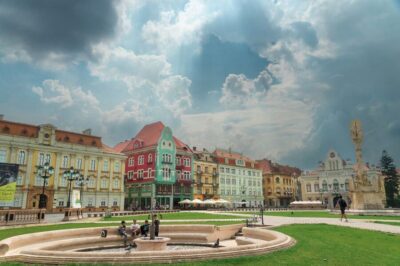
Full Day Trip from Belgrade: Uvac Nature Reserve Tour
Read our review →