
Review · NOVI SAD AND SREMSKI KARLOVCI
3 Hour Private Walking Tour in Novi Sad City
Novi Sad rewards slow footsteps. This private walk links its churches, grand squares, museums, markets, and wartime memorials into one clear story of a city shaped by Serbian, Hungarian, Austrian, Croatian, Jewish, and other influences. I like the small private format and the way the tour connects architecture with politics and daily life. I also like that coffee or lemonade is included during a break.
The main drawback is simple: transport from Belgrade is not included, and the tour actually begins in Novi Sad. You will need to arrange your own bus or train, and the listed duration is about 2 hours 30 minutes even though the product title says 3 hours. That is worth noting when you plan your day.
In This Review
- Key points before you book
- Why Novi Sad makes a fine walking city
- Trg slobode and the city’s Catholic beginning
- Zmaj Jovina Street and the city’s grand facades
- Merchant wealth on Svetozara Miletića and Grčkoškolska
- Matica Srpska and an unexpected Einstein connection
- Orthodox Novi Sad at St. George’s Church and the Bishop’s Palace
- Peter I, the Fish Market, and a sensible coffee break
- Museums, Danube Park, and the view toward Petrovaradin
- The Danube memorial and the hard years of World War II
- City government and Serbia’s national art institutions
- The synagogue and Serbian National Theatre
- Pace, walking demands, and who will enjoy it
- Should you book this Novi Sad walk?
- FAQ
- Where does the tour start?
- Where does the tour finish?
- How long does the walking tour last?
- How many people can join the private tour?
- Is transportation from Belgrade included?
- Is the tour offered in Belgrade?
- Are entrance tickets included?
- Is coffee included?
- Does the tour visit the interior of Petrovaradin Fortress?
- What happens if the weather is poor?
- Can I cancel for a full refund?
Key points before you book
- A private walk for up to four people: The $57.82 group price becomes especially good value when shared by three or four people.
- A strong history and architecture focus: You move from Catholic and Orthodox churches to banks, palaces, museums, a synagogue, and a national theatre.
- Vadim brings a lively guiding style: The available feedback praises his historical and artistic knowledge, humor, and ability to adjust the walk to the group.
- No admission fees are built into the route: Most stops are exterior visits, with optional looks inside the Name of Mary Church and St. George’s Orthodox Church.
- Coffee or lemonade is included: The break takes place along Dunavska Street, where the tour identifies non-smoking cafés.
- You see Petrovaradin Fortress from across the Danube: It is a view and history stop, not a fortress visit.
Why Novi Sad makes a fine walking city
Novi Sad is easier to read on foot than from a vehicle. Its center is compact, mostly flat, and full of buildings that tell you who held influence at different times. Catholic churches, Orthodox institutions, Jewish heritage, Austro-Hungarian design, Serbian cultural centers, and socialist-era memorials all appear within a fairly short walk.
That mix is the real reason to choose this experience instead of simply photographing the main square. You are not only shown a handsome façade. You are given a reason for its shape, its language, its religious mix, and its place in northern Serbia.
The tour is also useful if you are coming from Belgrade for the day. Buses and trains make the connection easy, but you must handle that part yourself. Arrive in Novi Sad before the start time, since the meeting point is Trg slobode, the city’s central square.
At $57.82 per group of up to four, the value depends on your party size. Four people pay about $14.46 each, while a solo visitor pays the full group rate. For a private guide who can answer your questions and adjust the pace, that is a reasonable price, especially since a coffee or lemonade is included.
More Novi Sad trips:
- Northern Serbia: Sremski Karlovci and Novi Sad Full-Day Tour from Belgrade
★ 5.0 · 425 reviews - From Belgrade: Novi Sad and Sremski Karlovci Tour
★ 4.5 · 101 reviews - Private transfer from Belgrade or Belgrade Airport to Novi Sad
★ 5.0 · 38 reviews
Trg slobode and the city’s Catholic beginning
The walk starts at Trg slobode, or Liberty Square, where the Name of Mary Church gives you an immediate introduction to Novi Sad’s Central European character. This is the city’s main Catholic church, and you may look inside if conditions allow.
The church works well as a first stop because it makes the religious contrast with later parts of the tour easy to understand. You begin with a Catholic landmark, then later visit the main Orthodox church. The guide uses that contrast to explain how Austro-Hungarian rule affected local architecture and how Catholic and Orthodox traditions differ.
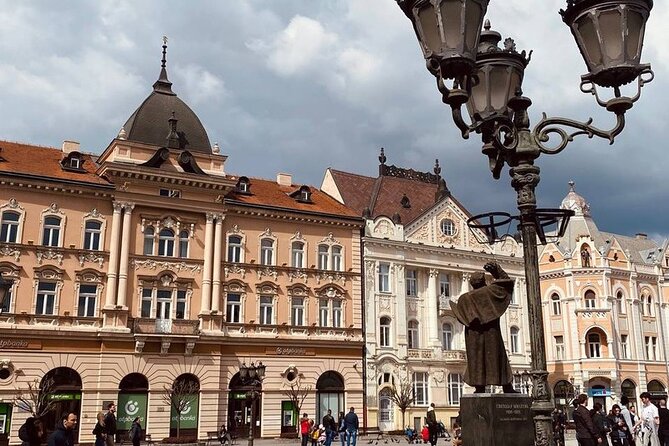
The City Hall is nearby. You see its exterior and hear about the first Serbian mayor of Novi Sad, along with the monument made by a well-known Croatian sculptor. This is also where the city’s multinational character gets proper attention.
Do not expect a long museum-style stop here. The listed time is short, but the subject is important. Novi Sad’s identity cannot be explained by one nation or one church alone, and this early section sets up the rest of the walk.
Zmaj Jovina Street and the city’s grand facades
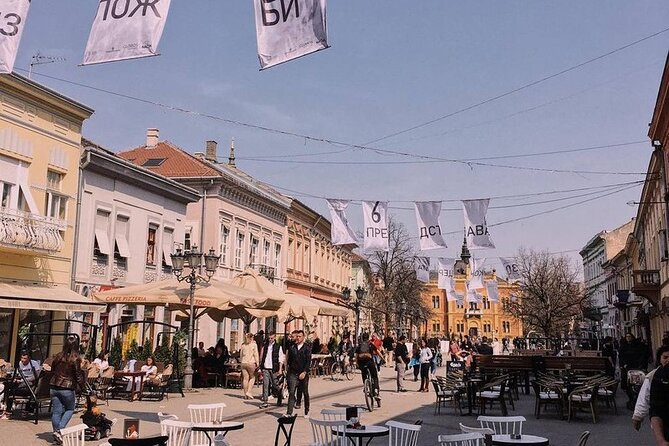
From the square, you continue along Zmaj Jovina Street, the main pedestrian road. It is named for Jovan Jovanović Zmaj, one of Serbia’s best-known poets, and the tour includes his monument.
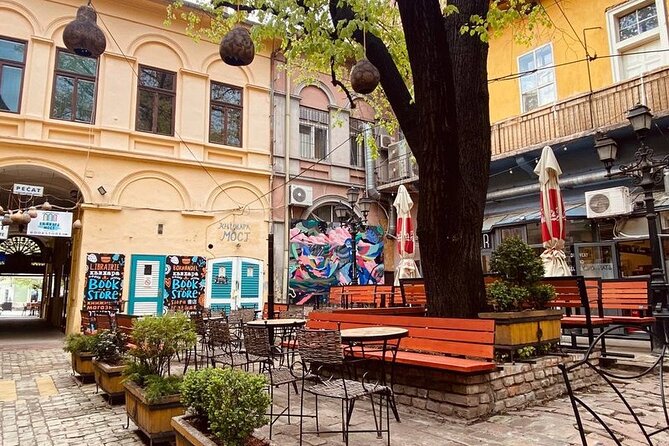
The street is more than a place to stroll and take pictures. You look into courtyards and see a notable Bauhaus-style building, giving the walk a useful range of architectural periods. Novi Sad does not present its history in one tidy style. Older merchant buildings, Austro-Hungarian forms, and modernist touches sit close together.
I like this part because it encourages you to look above street level. Courtyards and upper façades are easy to miss when you are moving alone, especially on a busy pedestrian street. The guide’s focus on architecture and art should suit anyone who wants more than a list of dates.
Merchant wealth on Svetozara Miletića and Grčkoškolska
The route then turns toward Svetozara Miletića Street, where the guide discusses a mansion connected with mass executions during World War II. That change in mood is deliberate. Novi Sad’s attractive streets also carry painful memories, and this stop keeps the walk from becoming a parade of pretty buildings without context.
You also see what is described as one of the city’s most expensive areas, with several important architectural works. One highlight is a former bank building topped by a monument of Mercury. The detail is small but telling: commerce, wealth, and European influence left their mark on the city center.
On Grčkoškolska Street, you follow the former homes of Novi Sad’s wealthiest residents. The most famous balcony belongs to a merchant who built the building now associated with Matica Srpska, Serbia’s key cultural institution.
This section will appeal to anyone interested in how money shapes a city. You are not just looking at grand homes. You are seeing where merchants lived, how institutions were funded, and how cultural life grew out of private wealth.
More city tours in Belgrade:
- Taxi to/from Belgrade Airport to/from Belgrade City Center
★ 5.0 · 241 reviews - Belgrade Underground Tour w/ Sparkling Wine Along the River
★ 5.0 · 151 reviews - Belgrade Sightseeing Half-Day Trip Old and New Belgrade
★ 4.5 · 71 reviews - Belgrade Private City Tour
★ 5.0 · 41 reviews
Matica Srpska and an unexpected Einstein connection
Matica Srpska Library is one of the most important cultural centers in Serbia. The stop helps explain why Novi Sad is often treated as a major intellectual and artistic center in the country, not simply as a pleasant provincial city.
The surrounding street also carries an unusual connection to Albert Einstein and his Serbian wife. They spent several months here, according to the tour’s historical account. It is a memorable detail because it links an otherwise quiet city street to a much wider European story.
The stop lasts about ten minutes, so you should think of it as an introduction rather than a full library visit. The emphasis is on the institution’s role and the city’s cultural life. If you want to enter every museum and church, you will need extra time beyond the walk.
Orthodox Novi Sad at St. George’s Church and the Bishop’s Palace
Saborna crkva, the Orthodox Cathedral Church of St. George, provides the tour’s clearest religious counterpoint to the Name of Mary Church. You can optionally look inside, while the guide explains Orthodox traditions and the influence of the Austro-Hungarian Empire on the region’s built environment.
The comparison is practical and useful. Even if you know the broad difference between Catholic and Orthodox Christianity, seeing both churches in one city makes the distinction more concrete. The architecture also shows how local traditions adapted within a larger imperial setting.
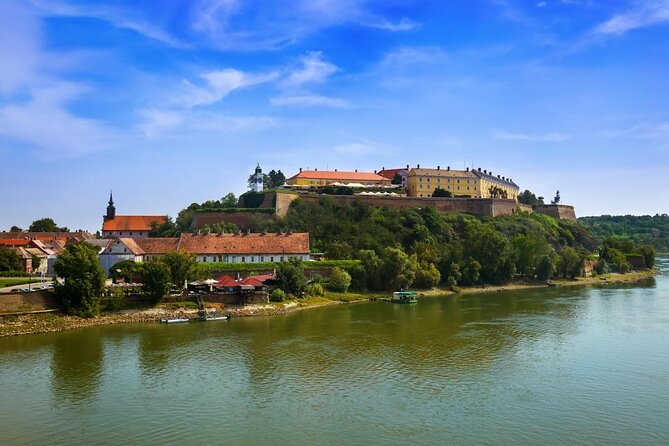
Next comes Vladicanski Dvor, the Orthodox Bishop’s Palace. You see the exterior, which has a more traditional Serbian architectural character and links to the southern parts of the country.
From there, the walk continues to the oldest Turkish well, dating to 1720, and a mural featuring major historical figures connected with Novi Sad. These details help you notice that the city’s story includes Ottoman-era traces as well as Habsburg and Serbian chapters.
Peter I, the Fish Market, and a sensible coffee break
At the monument to Peter I of Serbia, the guide explains the king’s historical role. The stop then moves to the Fish Market, a place used by locals and also associated with evening events.
This is a useful change from formal landmarks. Markets show how a city functions day to day, even when you are not shopping. The tour does not promise a food tasting, so you should think of this as a local setting and history stop rather than a culinary activity.
Dunavska Street follows. It is one of the oldest streets in Novi Sad and includes non-smoking cafés, which are not always easy to find in Serbia. You receive coffee or lemonade during the short break.
That included drink is a small but welcome feature. A walking tour covering this many stops benefits from ten minutes to sit, ask questions, and reset your feet. The break also makes the experience feel less like a timed march through the center.
Museums, Danube Park, and the view toward Petrovaradin
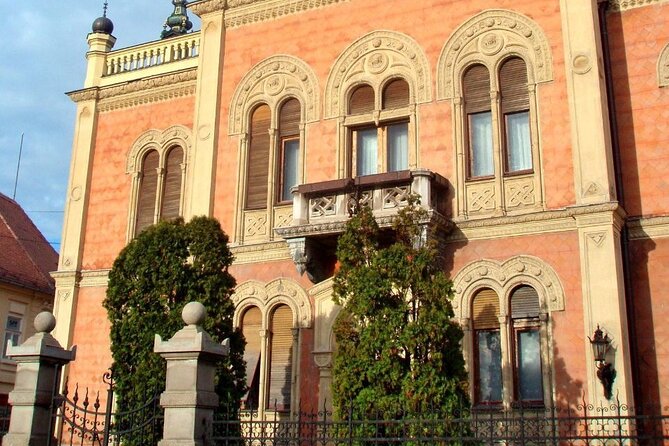
The next stretch is sometimes called the street of museums. You pass the Museum of Novi Sad, which holds European masters, the Museum of Vojvodina with archaeological displays, and the Museum of Contemporary Art, which presents temporary exhibitions.
The tour only gives you a look at these institutions from the route. It does not include museum admission or a dedicated indoor visit. Still, the guide can help you decide which museum deserves your extra time if you remain in Novi Sad after the walk.
Nearby Danube Park dates from the end of the 19th century. It gives the center a green pause before the route turns toward the river. The park is also a good reminder that Novi Sad was planned not only around commerce and government, but around public recreation.
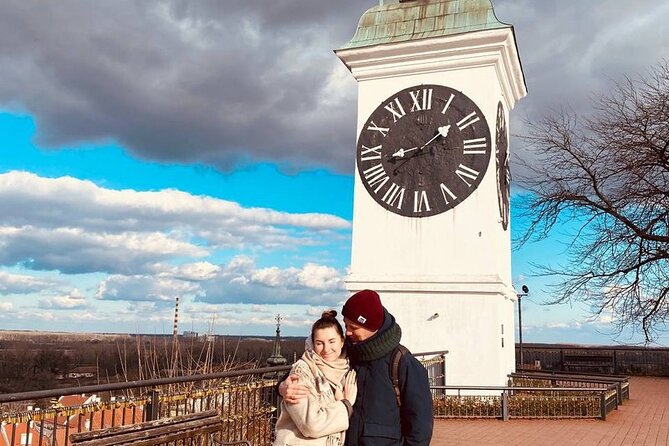
Petrovaradin Fortress appears across the Danube. You learn about its role in Novi Sad’s history and get a clear view of one of the city’s defining symbols. Be aware of the wording here: this stop is about seeing the fortress from the city side. The walk does not take you across the river or through the fortress itself.
If Petrovaradin is high on your list, plan a separate visit. This tour gives you context and a good city-center view, but not the full fortress experience.
The Danube memorial and the hard years of World War II
The Monument to the Victims of Fascism stands along the Danube embankment. This is one of the most serious stops, tied to the Novi Sad massacre of 1942.
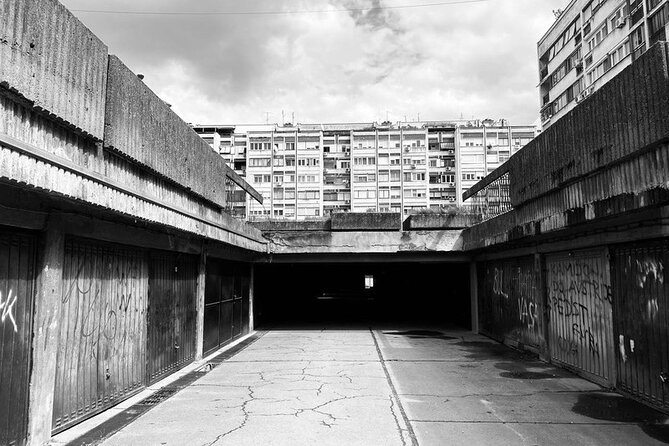
The guide discusses the events, Serbia’s role in World War II, and the creation of Socialist Yugoslavia. The subject may feel heavy after the lighter architecture and café stop, but it is essential to understanding the city.
This part is especially valuable because the tour does not treat history as a string of royal names and attractive buildings. It addresses violence, political change, and the way public memory is marked in the city. Give yourself time to listen rather than rushing toward the next photograph.
City government and Serbia’s national art institutions
The exterior of the Novi Sad City Assembly is another architectural highlight. The building is notable in part because of the decade in which it was built, and the stop explains how the city operates and why northern Serbia matters to the country.
The nearby Gallery of Matica Srpska is described as the most important gallery of Serbian art in Serbia. Two other galleries are located on the same square, one devoted to modern art and another to contemporary art.
Again, the tour focuses on exteriors and orientation. That is useful if you have limited time, since you can see where the cultural institutions are and return later for a proper visit. It is less suitable if your main goal is spending the afternoon inside galleries.
The synagogue and Serbian National Theatre
Novi Sad Synagogue is one of the most striking final stops. It is no longer active as a synagogue and now functions as a concert hall, but its design still shows the former importance of the Jewish community in the city.
The building was designed by Lipot Baumhorn, a prominent Novi Sad architect. Even from the outside, it offers another piece of the city’s religious and cultural story. Along with the Catholic and Orthodox churches, it helps you see Novi Sad as a place shaped by several communities.
The Serbian National Theatre is the final stop. The guide discusses the role of theatre in national identity, answers questions, and offers recommendations before returning you to Trg slobode.
That ending works well. You finish not with a final monument alone, but with a chance to ask what to see next, where to eat, or which museum deserves your remaining time.
Pace, walking demands, and who will enjoy it
The tour requires moderate physical fitness. You walk for roughly two and a half hours, with many brief stops and one short café break. Since most stops are exterior, comfortable shoes and weather-appropriate clothing matter more than formal attire.
The private format is a real advantage. Your group can ask about architecture, Serbian history, religion, or local culture without holding up a large party. The available feedback specifically praises Vadim for his lively humor, strong grasp of history and art, and adaptable approach.
Weather matters. The activity requires good conditions, so poor weather can lead to a different date or a full refund. You can cancel for a full refund up to 24 hours before the start time, but changes or cancellations inside that window are not accepted.
This walk suits first-time visitors who want a clear introduction to Novi Sad, couples or families who prefer a private guide, and day-trippers arriving from Belgrade. It also suits repeat visitors who want to connect familiar sights with politics, religion, art, and wartime memory.
It is less suitable if you want a fortress tour, extended museum visits, food sampling, or transportation from Belgrade included in the price.
Should you book this Novi Sad walk?
I would book it if you want context rather than a checklist. The route covers an impressive range of places, and the strongest feature is the way the guide links architecture to Novi Sad’s mixed cultural past.
Book with a little planning. Arrange your own bus or train from Belgrade, arrive at Trg slobode, and leave extra time if you want to enter museums or visit Petrovaradin Fortress properly. For a group of four, the price is particularly attractive.
Skip it if you only want independent wandering or need a tour that handles transportation. But if you have one day in Novi Sad and want its churches, art institutions, markets, memorials, and streets to make sense, this private walk is a practical choice.
FAQ
Where does the tour start?
It starts at Trg slobode in Novi Sad, Serbia.
Where does the tour finish?
The activity ends back at the meeting point in Trg slobode.
How long does the walking tour last?
The approximate duration is 2 hours 30 minutes. The experience title refers to three hours.
How many people can join the private tour?
The price covers one private group of up to four people.
Is transportation from Belgrade included?
No. Private transportation is not included. You arrange your own bus or train to Novi Sad.
Is the tour offered in Belgrade?
The supplied location information names Belgrade, but the meeting point and walking route are in Novi Sad. You should plan to begin in Novi Sad.
Are entrance tickets included?
The listed stops have no admission charge, and the tour mainly visits exteriors. Looking inside the Name of Mary Church and St. George’s Orthodox Church is optional.
Is coffee included?
Yes. Coffee or lemonade is included during a short break on Dunavska Street.
Does the tour visit the interior of Petrovaradin Fortress?
No interior visit is described. You see Petrovaradin Fortress from across the Danube and learn about its role in Novi Sad’s history.
What happens if the weather is poor?
If the activity is canceled because of poor weather, you are offered another date or a full refund.
Can I cancel for a full refund?
Yes. You must cancel at least 24 hours before the experience start time for a full refund. Changes or cancellations made less than 24 hours before the start are not accepted.
More Walking Tours in Belgrade
- Belgrade: 3-Hour Small Group Walking Tour
★ 5.0 · 180 reviews - Half-Day Sightseeing and Walking Tour of Belgrade City
★ 5.0 · 37 reviews - Belgrade Private Walking Tour with a Local
★ 5.0 · 19 reviews - Belgrade City Walk, Gathering and Sightseeing
★ 5.0 · 19 reviews
Just added in Belgrade
- Private Half Day Serbia Tour Novi Sad and Petrovaradin Fortress★ 5.0 · 3 reviews
- Zasavica Bike Tour★ 5.0 · 1 review
- Private Belgrade Street Art and Adventures Walking Tour★ 5.0 · 4 reviews
- Private Wine Tasting by Party in Belgrade★ 5.0 · 3 reviews
- VIP Reservation Service in Belgrade★ 5.0 · 2 reviews
- Urban & Alternative Belgrade tour★ 5.0 · 4 reviews
- Rakija Tasting for groups in Belgrade★ 5.0 · 1 review
- Wonders of Eastern Serbia a Full Day Tour from Belgrade★ 5.0 · 1 review
Novi Sad and Sremski Karlovci, compared.
Northern Serbia: Sremski Karlovci and Novi Sad Full-Day Tour from Belgrade
Read our review →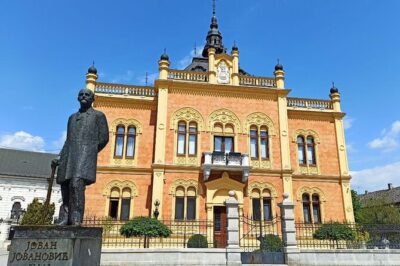

Private transfer from Belgrade or Belgrade Airport to Novi Sad
Read our review →
Private Day Tour to Fruska Gora Monasteries, Sremski Karlovci and Novi Sad
Read our review →Private Novi Sad, Titanic wine tasting and Farmer’s House
Read our review →
Private Day Tour Discovering Hidden Gems of Novi Sad in Luxury
Read our review →
Northern Serbia: Sremski Karlovci, Petrovaradin Fort & Novi Sad
Read our review →
Novi Sad and Sremski Karlovci private tour with wine tasting
Read our review →Browse the lists this tour appears in