
Review · HISTORICAL TOURS
Football tour: Red Star and Partizan Ultras History
Football can explain a city fast. This Belgrade walking tour uses the rivalry between Red Star and Partizan to show you fan neighborhoods, fierce supporter culture, stadium traditions, and Serbian football history. I like the mix of street art and stadium access, and I like that the tour includes both sides rather than treating one club as the whole story. The main consideration is the pace: with several stops and up to three or four hours on foot, you will want comfortable shoes and enough energy for a full morning.
The tour costs $84.21 per person and starts at 10:00 a.m. from Student Park, Studentski trg 16. I especially like the chance to have a beer inside one stadium and the personal touch shown by guides such as Andrija, who helped one participant attend a Red Star match later that day and even joined a basketball game the following day. Still, the experience is best for people with a real interest in football, supporter culture, or modern Serbian history, not for someone seeking a general sightseeing walk.
In This Review
- Key points to know before you book
- Why this Belgrade football tour is different
- Dorcol: Partizan supporters and an easygoing neighborhood
- Senjak: Red Star territory and a protected piece of fan culture
- Red Star’s Marakana: trophies, flags, and a major European prize
- Partizan Stadium: an unusual final look at Belgrade football
- What the guides add to the experience
- Is $84.21 a fair price?
- Who should book, and who should skip it
- Final call: a strong choice for football-minded visitors
- FAQ
- Where does the tour start?
- What time does the tour begin?
- How long does the tour last?
- Does the tour finish at the starting point?
- Is the tour offered in English?
- What neighborhoods are included?
- Can you visit both stadiums?
- Is the stadium museum included?
- Can you cancel for a full refund?
Key points to know before you book
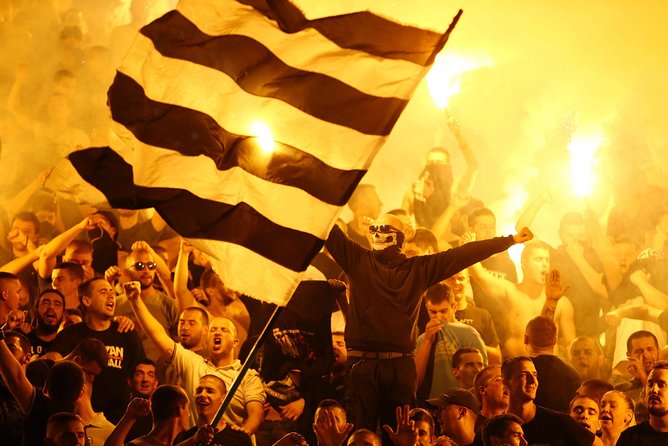
- Two rival fan districts: Walk through Dorcol, associated with Partizan, then Senjak, associated with Red Star.
- Old supporter graffiti: Senjak has a Red Star mural dating from the 1990s, said to be watched over by supporters around the clock.
- Red Star’s Marakana: Visit the stadium museum, see club trophies and flags, and view the 1991 Champions League Trophy.
- Partizan pitch access: Walk down onto the pitch and see a stadium described as one of Europe’s last remaining ghetto stadiums.
- A guide-led experience: Guides including Andrija and Tihomir bring personal knowledge of Serbian football and fan culture.
- Flexible cancellation: You can cancel for a full refund up to 24 hours before the 10:00 a.m. start.
Why this Belgrade football tour is different
Most city tours point out churches, squares, and old buildings. This one reads Belgrade through its football loyalties. You see where supporters gather, how clubs mark their territory, and how a rivalry reaches beyond the ninety minutes played on a pitch.
That makes the tour useful even if you know little about Serbian football. The neighborhoods provide a setting for the story. Graffiti, bars, pubs, stadium walls, and club symbols show you how fandom becomes part of daily city life.
I also appreciate the two-club format. Red Star and Partizan are major rivals, so visiting both districts and both stadiums gives you a more balanced view. You are not simply being taken to one famous ground for photographs. You get a comparison between two identities that share the same city.
The social side matters, too. A strong guide can turn football facts into a window on Serbia. Tihomir is praised for his grasp of ultras culture, while Andrija is described as warm, helpful, and eager to keep sharing Belgrade beyond the scheduled tour. That kind of guide can make a structured morning feel more like time spent with a local football friend.
More history tours in Belgrade:
- History and Culture in my Belgrade
★ 5.0 · 41 reviews - NATO Bombing of Belgrade Historical Tour
★ 5.0 · 17 reviews - Tito and History Vintage Car Tour
★ 5.0 · 11 reviews
Dorcol: Partizan supporters and an easygoing neighborhood
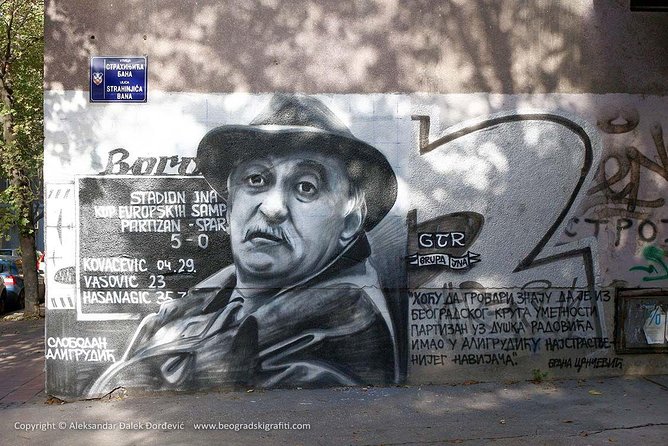
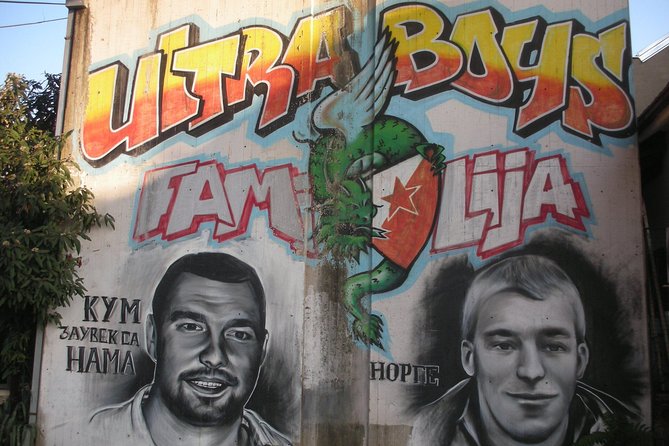
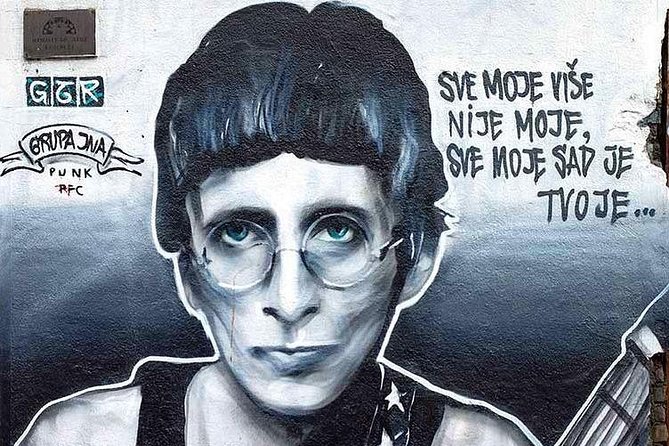
The first major stop is Dorcol, a central Belgrade neighborhood linked with Partizan supporters. You will see graffiti connected to the club and its famous fan groups, including imagery tied to one of the city’s most forceful supporter communities.
The setting gives this stop extra appeal. Dorcol is not only a football district. It is also known for bars, pubs, and an attractive neighborhood feel. You can look at supporter art, then notice how ordinary city life carries on around it. That contrast is part of the point. The fan identity is strong, but it exists beside cafés, local streets, and social spaces.
Plan on about an hour here. That is long enough for the guide to explain the symbols and the people behind them, rather than rushing past a wall for a quick photograph. You should also have a chance to ask questions about Partizan’s place in Belgrade and how supporter groups shape the club’s public identity.
There is no separate admission charge for the Dorcol stop. The value comes from the interpretation. Without a guide, graffiti can look like colorful wall decoration. With context, it becomes evidence of rivalry, memory, and neighborhood belonging.
One practical point: this is a walking stop, and the full experience continues through more districts and stadium grounds. Wear shoes that can handle several hours of walking. The meeting point is Student Park, so you should arrive ready to walk at the scheduled 10:00 a.m. start.
Senjak: Red Star territory and a protected piece of fan culture
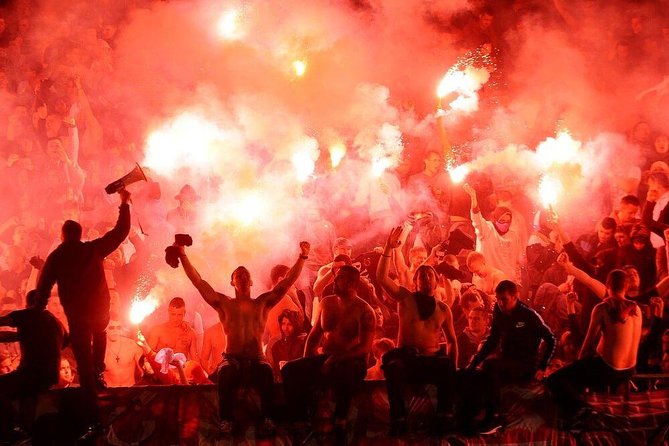
The tour then moves to Senjak, a neighborhood connected with Red Star supporters. The stop lasts about 20 minutes, so it is shorter than Dorcol, but its main feature carries unusual weight: graffiti dating from the 1990s, described as the oldest of its kind in Belgrade.
The mural is said to be guarded by Red Star supporters around the clock. That detail gives you a sense of how seriously some fans treat these public marks of identity. It also helps explain why football supporter culture in Belgrade is not just about match-day noise. Club loyalty can shape territory, memory, and local pride.
Senjak gives you a direct comparison with Dorcol. Instead of hearing about both clubs in an abstract way, you physically move from one side of the rivalry to the other. The neighborhoods help you understand that Red Star and Partizan are not simply two teams competing for a score. Their supporters attach meaning to streets, walls, and shared city space.
Because the stop is brief, you should not expect a long neighborhood tour here. Its purpose is focused: see the famous old graffiti, understand why it matters, and place Red Star’s supporters within the wider story. The value comes from the guide’s explanation, especially if you are new to Serbian ultras culture.
Red Star’s Marakana: trophies, flags, and a major European prize
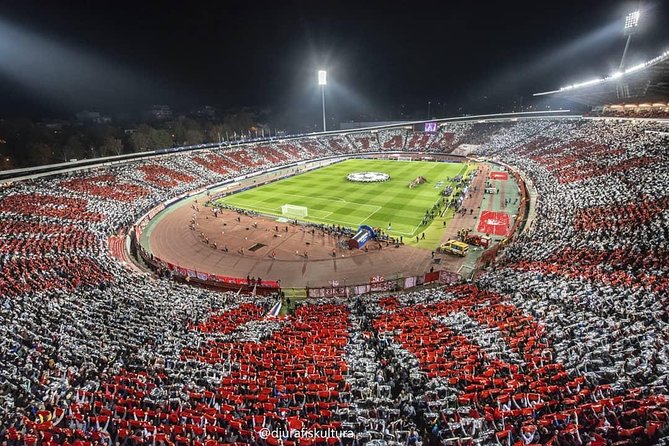
The longest part of the tour is at Red Star Belgrade Stadium, widely known as Marakana. Allow about two hours here, including the stadium and museum visit.
The museum contains trophies, flags, and important club documents. The most notable object is the 1991 Champions League Trophy. Red Star is identified as one of only two Eastern European clubs with this prize, alongside Steaua Bucharest. For football fans, that gives the museum a clear reason to visit. You are not just seeing a local club collection. You are seeing an object connected to one of the biggest achievements in European club football.
The museum also helps place modern Red Star within a longer club story. Trophies show success, but flags and documents can reveal how supporters and the institution present that success. A guide can explain which moments matter most and why the 1991 victory carries such importance.
The stadium visit is likely to be the emotional high point for Red Star supporters. Even if you support another club, standing inside a famous ground gives the football story a physical setting. You can connect the club’s honors with the place where its match-day identity lives.
A beer inside one of the stadiums is another appealing feature. The supplied information does not specify exactly where or when this happens, so ask your guide at the start. It is a small touch, but it fits the character of the experience better than a museum-only visit.
The Red Star portion also seems to allow some flexibility. One participant had the chance to go onto the pitch and view conference rooms as part of a customized visit. You should not assume those extras are guaranteed, but it is worth asking whether stadium access can be adjusted on your date.
A completely different kind of day:
- Northern Serbia: Sremski Karlovci and Novi Sad Full-Day Tour from Belgrade
★ 5.0 · 425 reviews - Day Trip from Belgrade: Gems of Eastern Serbia
★ 5.0 · 424 reviews - Belgrade Nightlife Bar Pub Club Crawl with Drinks
★ 5.0 · 277 reviews - Taxi to/from Belgrade Airport to/from Belgrade City Center
★ 5.0 · 241 reviews
Partizan Stadium: an unusual final look at Belgrade football
The final stadium stop is Partizan Stadium. The visit lasts around 30 minutes and includes walking down onto the pitch. That access changes the feel of the tour. You are not only looking at the field from the stands. You get closer to the playing surface and can consider the ground from the same basic level as the players.
The stadium is described as one of Europe’s last remaining ghetto stadiums. That phrase points to its rougher, less polished character. You should not come expecting a glossy modern arena. Its appeal is the opposite: a stadium with a more worn and distinctive feel, tied to the city’s supporter culture.
The stop also offers strong views of Belgrade, according to the account of one tour participant. If photography matters to you, this may be one of the better parts of the morning. The combination of pitch access, stadium structure, and city views gives the Partizan visit a different character from the museum-focused Red Star stop.
The shorter duration works well here. After an hour in Dorcol, a brief Senjak visit, and roughly two hours at Marakana, you may be ready for a focused final stop rather than another long presentation. You still get a clear sense of Partizan’s home ground without stretching the tour far beyond its stated three-to-four-hour length.
What the guides add to the experience
The guide is central to the quality of this tour. Football graffiti and stadium corridors have limited meaning if nobody explains the clubs, supporter groups, and social effects behind them.
Tihomir is praised for his professional manner and strong grasp of ultras history. That is important because the subject can easily become a simple list of chants, rivalries, and famous matches. The better version connects football culture with Serbia’s past and with the way supporters influence city life.
Andrija receives especially warm praise for his hospitality and his knowledge of Serbian football. His role went beyond showing the planned stops. He helped one participant attend a Red Star match later that day and joined a basketball game the next day. You should not book on the assumption that your guide will arrange extra events, but this example shows the kind of personal connection the company may offer.
The tour is offered in English. Group discounts are available, and the maximum group size is listed as 99 people. That maximum is quite large, so the actual feel may depend on the number booked for your date. If you prefer close conversation and easy questions, ask about the expected group size before reserving.
Is $84.21 a fair price?
At $84.21 per person, this is not a cheap general walking tour. The value depends on your interests and on how much access you receive at the stadiums.
For a football fan, the price covers several distinct elements: guided walks in two supporter districts, explanations of Red Star and Partizan culture, entry to the Red Star stadium museum, access to Partizan Stadium, and the time of a specialist guide. The 1991 Champions League Trophy alone gives the Red Star visit a major point of interest.
The price is harder to justify if you have only a passing interest in football. Dorcol and Senjak can be interesting neighborhoods, but the tour’s main purpose is not architecture, food, or broad city sightseeing. You are paying for context about clubs and ultras culture.
I see the strongest value in the two-stadium format. A single stadium visit can feel brief. Here, you compare two rivals and see how their supporters mark different parts of Belgrade. If you also make use of the guide’s help with local sports events, the experience can become more valuable, though extra events are not part of the stated tour promise.
Group discounts may improve the price for couples, families, or friends booking together. The mobile ticket is convenient, and confirmation arrives at booking. Those are small practical benefits, but they reduce friction on the morning.
Who should book, and who should skip it
I would recommend this tour to you if you enjoy European football, club rivalries, stadium design, supporter art, or the social side of sport. You do not need to know every Serbian player or every famous match. Curiosity is enough, provided you want to spend several hours on football rather than general sightseeing.
It also suits people who want to see Belgrade through a local subject. The walk links neighborhoods to identity, and the stadium visits show how that identity is presented to the public. You get a different angle on the city than you would from a standard center walk.
The tour may also work well for a sports-focused family or a small group of friends. Most people can participate, service animals are allowed, and the meeting point is near public transportation.
I would skip it if you dislike walking, have no interest in football, or want a relaxed museum visit with little commentary. The subject is supporter culture, including fierce rivalries and ultras history. That can be fascinating, but it is not a neutral, all-purpose introduction to Belgrade.
The weather matters because the experience requires good conditions. If poor weather causes cancellation, you can choose another date or receive a full refund. You can also cancel for a full refund up to 24 hours before the start time. Changes or cancellations within 24 hours are not accepted, so keep the local cut-off time in mind.
Final call: a strong choice for football-minded visitors
I would book the Red Star and Partizan Ultras History Tour if you want a focused, local look at Belgrade’s football identity. The two fan districts, the Red Star museum, the 1991 Champions League Trophy, and pitch access at Partizan create a full morning rather than a quick stadium photo stop.
The best reason to book is the guide. Tihomir’s grasp of ultras culture and Andrija’s personal warmth can turn facts into a memorable connection with the city. Just arrive prepared for walking, confirm the exact stadium access available on your date, and choose this tour because you care about football culture, not because you want a general Belgrade introduction.
FAQ
Where does the tour start?
The tour starts at Student Park, Studentski trg 16, Belgrade 11000, Serbia.
What time does the tour begin?
The scheduled start time is 10:00 a.m.
How long does the tour last?
The experience lasts approximately three to four hours.
Does the tour finish at the starting point?
Yes. The activity ends back at the meeting point.
Is the tour offered in English?
Yes. The tour is offered in English.
What neighborhoods are included?
The tour visits Dorcol, associated with Partizan supporters, and Senjak, associated with Red Star supporters.
Can you visit both stadiums?
Yes. The tour includes Red Star Belgrade Stadium, also called Marakana, and Partizan Stadium.
Is the stadium museum included?
The Red Star stadium visit includes access to the museum with the same ticket. The museum contains trophies, flags, club documents, and the 1991 Champions League Trophy.
Can you cancel for a full refund?
Yes. You can cancel at least 24 hours before the experience starts for a full refund. Cancellations or changes made less than 24 hours before the start are not accepted, and poor-weather cancellations offer a different date or a full refund.
Just added in Belgrade
- Private Half Day Serbia Tour Novi Sad and Petrovaradin Fortress★ 5.0 · 3 reviews
- Zasavica Bike Tour★ 5.0 · 1 review
- Private Belgrade Street Art and Adventures Walking Tour★ 5.0 · 4 reviews
- Private Wine Tasting by Party in Belgrade★ 5.0 · 3 reviews
- VIP Reservation Service in Belgrade★ 5.0 · 2 reviews
- Urban & Alternative Belgrade tour★ 5.0 · 4 reviews
- Rakija Tasting for groups in Belgrade★ 5.0 · 1 review
- Wonders of Eastern Serbia a Full Day Tour from Belgrade★ 5.0 · 1 review
Historical Tours, compared.


Full-Day Private Royal Heritage Tour to Oplenac With a Winery Visit
Read our review →
The White Emigration in Serbia in the Wake of the Russian Revolution
Read our review →
Belgrade Time Travel – Half Day Historic Core Private Walking Tour
Read our review →Browse the lists this tour appears in