
Review · YUGOSLAV HISTORY TOURS
Private 4 Hours Space Architecture Tour in Belgrade
Belgrade tells its story in concrete. This private tour links the city’s boldest buildings, from Avala Tower to the Genex Tower, while your guide explains how architecture reflects Serbian and Yugoslav politics, culture, and ambition. I especially like the hotel pickup and drop-off, which saves you from piecing together distant sites by public transport, and the small private format, limited to your group of up to three people.
The route also reaches places that are awkward to visit independently. Guides such as Stefan, Novica, Nemanja, Mihailo, and Milos have been praised for clear storytelling and strong knowledge of Serbian history. The main drawback is the amount of time spent in the vehicle. Four hours includes all driving, so the sightseeing stops are short and this is best for people who want a focused introduction rather than a slow architectural study.
In This Review
- Key Points to Know Before You Book
- Why This Tour Matters in Belgrade
- Avala Tower: A Rebuilt Symbol Above Belgrade
- Eastern City Gate: Three Towers and a Socialist Vision
- Ada Bridge: Engineering Across the Sava
- Sava Center: Polyhedral Forms and International Ambition
- Palace of Serbia: Architecture as Government
- Belgrade Western Gate: The Genex Tower’s Brutalist Drama
- What the Guide Adds to the Concrete
- Four Hours, Six Stops, and the Value of Private Transport
- Who Will Enjoy This Experience Most?
- Practical Details That Shape the Day
- Should You Book the Space Architecture Tour?
- FAQ
- How long does the tour last?
- How many people can join the private tour?
- Is hotel pickup and drop-off included?
- Is admission to Avala Tower included?
- Is the tour offered in English?
- Can I cancel for a full refund?
Key Points to Know Before You Book
- Avala Tower begins the route with wide Belgrade views from the city’s tallest mountain.
- The Eastern City Gate and Genex Tower show brutalist architecture at full scale, with buildings designed as symbols as much as homes or offices.
- Your guide supplies political and social context, connecting concrete forms to Yugoslav socialism and postwar Belgrade.
- Private pickup makes the route practical, since the six stops are spread across the city and beyond.
- The tour covers a lot of ground in four hours, but most stops last only 15 to 20 minutes.
- The $175.14 group price is strongest for two or three people, since the cost is shared rather than charged per person.
Why This Tour Matters in Belgrade
Belgrade’s architecture is not just a collection of unusual shapes. Much of the city’s modern building came from a period when Yugoslavia wanted to present itself as modern, independent, and forward-looking. Large public buildings, new housing blocks, bridges, and towers carried political meaning.
That is the useful promise of this tour. You are not simply driven past concrete structures while someone recites dates. The best guides connect design with the society that produced it. One guide, Stefan, has academic degrees in history, while other guides have been praised for adding context about Serbia, Yugoslavia, culture, and daily life.
The private format should help you ask direct questions. If you are interested in brutalism, socialist-era planning, or the way governments use architecture to express power, you can shape the conversation around those subjects. The tour also works for curious visitors who do not know much about architecture but want to see a side of Belgrade beyond the central pedestrian streets and fortress.
Still, keep the schedule in perspective. The tour lasts about four hours, and that includes transportation. The route is efficient, but it is not leisurely. You will often spend 10 to 45 minutes getting from one location to the next, followed by a short visit. Think of it as a guided city-wide survey.
More Yugoslav history tours:
- Red Belgrade Communist Tour
★ 5.0 · 78 reviews - Architecture of New Belgrade – Brutalism Decoded
★ 4.5 · 24 reviews - Communist Tour in Belgrade
★ 4.5 · 19 reviews
Avala Tower: A Rebuilt Symbol Above Belgrade
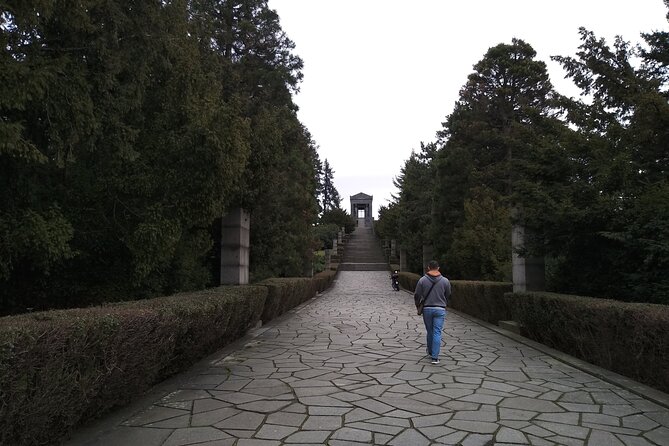
The first stop is Avala Tower, roughly 30 to 45 minutes from central Belgrade. The tower sits on Avala, the city’s tallest mountain, and its observation deck gives you a broad view across Belgrade and the surrounding area.
The tower has a history that adds weight to the visit. NATO bombing destroyed the original structure in 1999, and it was rebuilt in 2010. That makes Avala Tower more than a lookout. It represents loss, reconstruction, and the continuing importance of a national symbol.
You receive about 45 minutes here, with admission included. That is the longest stop on the route, and sensibly so. You have time to take in the view, examine the tower, and hear the story without being rushed through in a few minutes.
The drive up is also part of the experience. Avala is outside the city center, and reaching it by public transport would take more planning than simply following the rest of central Belgrade. Snow can sometimes cover the mountain, as it did during one reported visit, but the tour still reached the tower. Conditions can vary, so comfortable shoes and a warm layer are sensible choices.
Avala Tower is less about brutalism than the later stops. It works as an opening chapter, giving you a view of the city before you examine its major postwar buildings at street level.
Eastern City Gate: Three Towers and a Socialist Vision
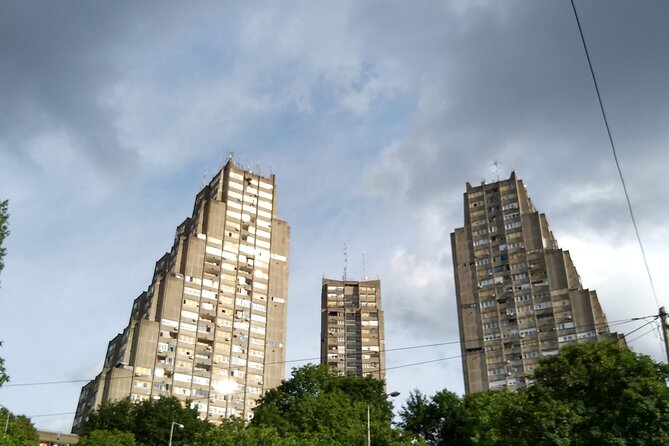
From Avala Tower, expect another 30 to 45 minutes by vehicle to the Eastern City Gate. Officially called Rudo, this complex consists of three residential towers, each about 85 meters high.
The three buildings are a clear example of brutalist design. Their size and repeated forms make them feel monumental, even though their original purpose was housing. That tension is part of what makes the site interesting. A residential complex can look like a civic monument when built at this scale.
You have around 20 minutes here, and the guide’s explanation matters more than a long walk. The towers are not a single isolated object that you can fully understand through one photograph. You need to see how the buildings relate to one another and hear why they became associated with Belgrade and Yugoslav socialism.
This is also one of the places where a private guide can offer more than a standard sightseeing bus. The Eastern City Gate is not beside the main tourist sights, and the experience is about reading the design rather than simply taking a quick picture. You may also gain a clearer sense of how postwar Belgrade used large housing projects to express a collective social ideal.
The stop is brief, so architecture students and serious photographers may want more time than the schedule allows. For most people, though, 20 minutes is enough to see the scale, get an explanation, and understand why the complex matters.
Ada Bridge: Engineering Across the Sava
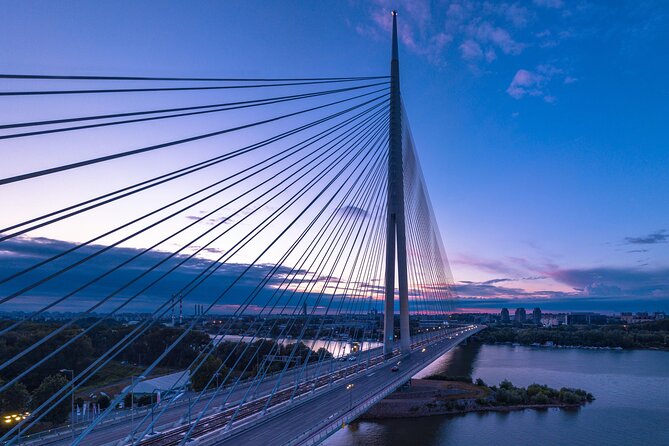
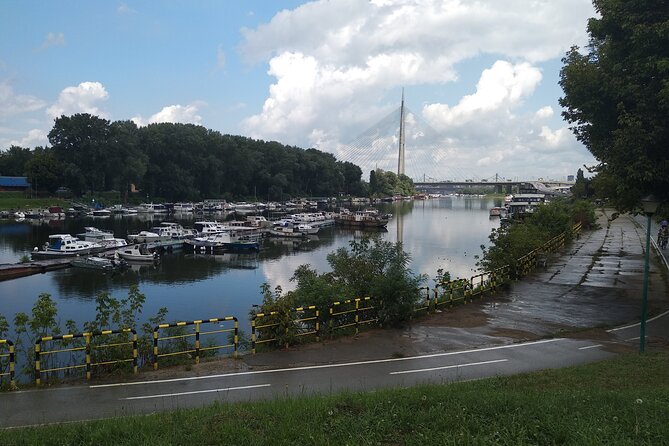
The transfer from the Eastern City Gate to Ada Bridge takes about 10 to 15 minutes. The visit includes crossing the bridge above the Sava River, with about 20 minutes set aside for the stop.
The bridge is known for its tall single pylon, and its construction was featured on the Discovery Channel. You do not need to be a bridge enthusiast to appreciate the change in scale here. After the heavy residential forms of Rudo, Ada Bridge shifts the focus to engineering, cables, height, and movement through the city.
The route lets you see the bridge as part of Belgrade’s wider structure rather than as an isolated object. A private vehicle is useful because you can connect it directly with the other architectural sites without organizing separate journeys across the river.
This is primarily a viewing and explanation stop, not a long walking excursion. The schedule does not promise an extended riverside visit, so you should not expect time for a relaxed stroll along the Sava. You will get a concise look at the bridge and its place in modern Belgrade.
A completely different kind of day:
- Northern Serbia: Sremski Karlovci and Novi Sad Full-Day Tour from Belgrade
★ 5.0 · 425 reviews - Day Trip from Belgrade: Gems of Eastern Serbia
★ 5.0 · 424 reviews - Belgrade Nightlife Bar Pub Club Crawl with Drinks
★ 5.0 · 277 reviews - Taxi to/from Belgrade Airport to/from Belgrade City Center
★ 5.0 · 241 reviews
Sava Center: Polyhedral Forms and International Ambition
About 10 minutes after crossing Ada Bridge, you reach Sava Center. The stop lasts around 15 minutes.
Sava Center was built for the 1977 Conference on European Security and Cooperation in Belgrade. It was the first and largest conference center in former Yugoslavia, which tells you a lot about the building’s purpose. This was architecture designed to host international diplomacy and display a country’s modern credentials.
The complex is notable for its polyhedral buildings and large structural design. Your guide can help you look beyond the overall size and notice how the forms work together. This is a good example of why the tour benefits from explanation. Without context, you might simply see a large conference facility. With context, you can read it as a statement about Yugoslavia’s place in Europe and the wider world.
The short visit is enough for an exterior overview. If you want to study every angle, enter the building, or spend time photographing details, 15 minutes will feel tight. The advantage is that the tour keeps moving and fits several important sites into one morning or afternoon.
Palace of Serbia: Architecture as Government
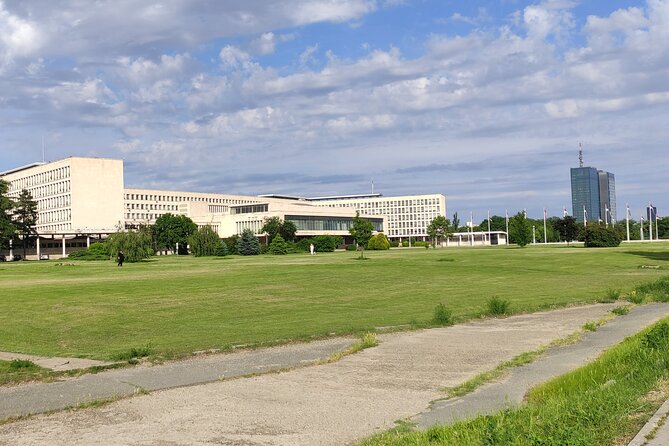
The next transfer is only about five minutes, taking you to the Palace of Serbia. You spend around 15 minutes in front of this large late-modernist building.
The Palace of Serbia was formerly the Federal Executive Council. It was the first major New Belgrade project after World War II and was built on an enormous scale. Its size was not accidental. Government architecture often tries to communicate authority, order, and permanence, and this building offers a clear example.
The tour frames the palace as a place where design represents ruling ideology. That idea is central to the whole experience. You are encouraged to ask what a building says about the people who commissioned it, the society it served, and the image it wanted to project.
The stop is viewed from outside, with no entrance fee listed. Fifteen minutes gives you time to examine the exterior and listen to the guide, but the building’s scale can be difficult to absorb quickly. Your guide’s interpretation helps turn a large facade into a readable piece of political and architectural history.
Belgrade Western Gate: The Genex Tower’s Brutalist Drama
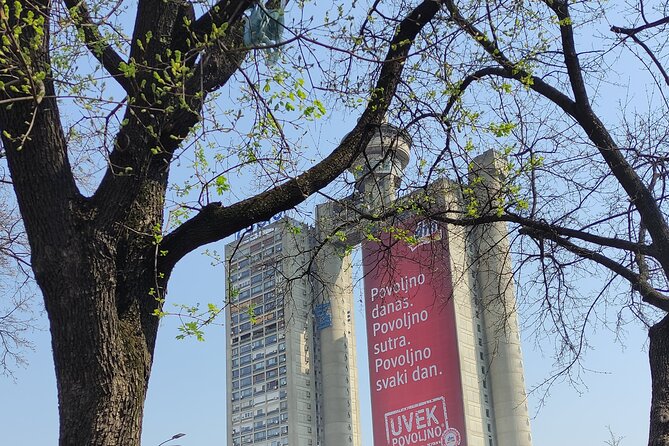
The final major stop is the Western City Gate, also called the Genex Tower. The drive from the Palace of Serbia takes about 10 minutes, followed by a 15-minute visit.
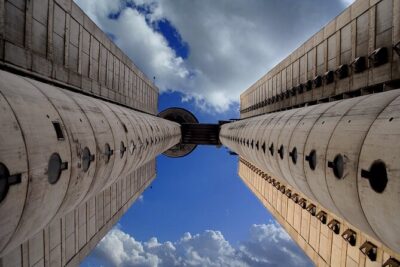
Designed by Mihajlo Mitrović in 1977, the structure is a 36-story skyscraper in the brutalist style. It is made of two towers connected by a two-story bridge, creating one of the most recognizable silhouettes in Belgrade.
The form is striking because it does not look like a conventional single tower. The paired blocks and connecting section give it a sense of motion and tension. It was designed as an entrance marker for the city, so its position and shape were part of its purpose.
This is one of the strongest stops for anyone interested in brutalism. You can see how architecture can be dramatic without relying on decoration. The raw mass, unusual arrangement, and height do the work.
Again, the schedule gives you an exterior visit rather than a full building tour. The short stop is enough to see the basic structure and hear the story, but it may leave serious architecture fans wanting more. If you have particular questions about the Genex Tower, bring them. The private format gives you the best chance to make this stop more than a photo opportunity.
What the Guide Adds to the Concrete
The guide is the main reason to choose this experience over a self-guided drive. The buildings are spread across Belgrade, and the value comes from connecting them.
Stefan has been praised for explaining architecture in a clear, friendly way while also sharing material about Serbian history, culture, and society. He has also provided online resources after the tour, which can help you continue exploring Belgrade later.
Novica has been described as passionate and entertaining, including during a snowy visit to Avala Tower. Nemanja received praise for adapting the program after guests shared specific interests in Yugoslav socialist architecture and monuments. Mihailo has been noted for offering a steady flow of information from the moment the vehicle leaves the hotel.
The driver can also add useful local knowledge. One particularly positive account described Milos as both a safe driver and an active part of the conversation. That matters on a route with several long transfers. You want a calm ride, clear timing, and someone who knows how to move between distant parts of the city.
Guide assignments can change, so you should not book solely to meet one named person. The repeated pattern is more important: the company has several guides who can explain both the buildings and the broader Serbian and Yugoslav setting.
Four Hours, Six Stops, and the Value of Private Transport
The tour costs $175.14 per group of up to three people. For one person, that is a fairly expensive half-day outing. For three people, the cost works out to about $58.38 each, before any personal spending, and the value improves considerably.
The price includes pickup from your accommodation, an air-conditioned vehicle, entrance fees, a professional guide, and return transportation. Avala Tower is the only stop with a listed admission charge, and it is included. The other stops are free to visit.
The strongest value is the vehicle and route planning. You are not paying only to see buildings. You are paying to connect sites that are spread across Belgrade and to avoid losing much of your day to navigation. Since transportation time is already included in the four-hour duration, you should not expect four full hours of walking and close inspection.
Pickup is offered from your address, and the tour runs Monday through Sunday from 9:00 a.m. to 5:00 p.m. The exact start time should be confirmed at booking. Mobile tickets and booking confirmation at the time of purchase make the practical side simple.
Personal expenses are not included. The supplied information does not list meals or extra purchases, but the route itself is built around transportation and sightseeing rather than food.
Who Will Enjoy This Experience Most?
I would recommend this tour most strongly to:
- People interested in brutalist and late-modernist architecture
- Visitors curious about Yugoslav socialism and postwar planning
- First-time visitors who want to see more than central Belgrade
- Couples or small groups who value private transport
- Architecture students, designers, photographers, and history enthusiasts
- Anyone with limited time who wants a structured overview of major sites
You do not need formal architecture training. The strongest part of the experience is the explanation, and the guides are praised for making complex subjects clear and entertaining.
I would be more cautious if you want long walks, interior visits, or extended time at each building. The tour covers six places in four hours, so it favors range over depth. It also includes substantial driving, especially to and from Avala Tower.
The route is not designed as a gentle central-city stroll. It is a city-wide outing that uses a vehicle to reach large, widely separated structures. That makes it practical, but it also means you should be comfortable with a fairly active schedule of getting in, getting out, listening, and moving on.
Practical Details That Shape the Day
The tour is private, so only your group participates. That gives you room to ask questions and request emphasis on particular subjects, though the supplied information does not promise a fully custom itinerary for every booking.
Service animals are allowed, and most people can participate. Pickup and drop-off at your accommodation reduce the need to reach a meeting point. An air-conditioned vehicle should make the longer transfers more comfortable, especially on a warm day.
Wear shoes suitable for walking around outdoor sites. Bring a phone or camera if you want to record the unusual towers and bridge, and consider a warmer layer for Avala, where conditions can differ from central Belgrade. Snow did not prevent one reported visit, but weather may affect comfort and views.
Free cancellation is available if you cancel at least 24 hours before the local start time. Changes or cancellations within 24 hours are not accepted for a refund.
Should You Book the Space Architecture Tour?
Book it if you want Belgrade explained through its buildings, not just photographed. The combination of Avala Tower, Rudo, Ada Bridge, Sava Center, Palace of Serbia, and Genex Tower gives you a strong introduction to the city’s postwar ambitions and socialist-era design.
The tour is especially worthwhile for two or three people sharing the group price. You receive a private vehicle, hotel pickup, a guide, and access to distant sites that are inconvenient to link on your own. The main compromise is time: short stops and long transfers mean you will survey the city rather than study every building closely.
If that trade suits you, this is an unusual and useful way to understand Belgrade. If you prefer interiors, long walks, or one building explored in detail, choose a slower architecture-focused experience instead.
FAQ
How long does the tour last?
The tour lasts approximately four hours, including transportation time between the stops.
How many people can join the private tour?
The price covers one private group of up to three people. Only your group participates.
Is hotel pickup and drop-off included?
Yes. Pickup and drop-off from your accommodation are included, and travelers are picked up from their address.
Is admission to Avala Tower included?
Yes. The itinerary lists an admission ticket for Avala Tower as included. The other listed stops have no admission fee.
Is the tour offered in English?
Yes. The tour is offered in English, and a mobile ticket is available.
Can I cancel for a full refund?
Yes, if you cancel at least 24 hours before the experience’s local start time. Cancellations or changes made less than 24 hours before the start are not refunded.
Just added in Belgrade
- Private Half Day Serbia Tour Novi Sad and Petrovaradin Fortress★ 5.0 · 3 reviews
- Zasavica Bike Tour★ 5.0 · 1 review
- Private Belgrade Street Art and Adventures Walking Tour★ 5.0 · 4 reviews
- VIP Reservation Service in Belgrade★ 5.0 · 2 reviews
- Private Wine Tasting by Party in Belgrade★ 5.0 · 3 reviews
- Urban & Alternative Belgrade tour★ 5.0 · 4 reviews
- Rakija Tasting for groups in Belgrade★ 5.0 · 1 review
- Wonders of Eastern Serbia a Full Day Tour from Belgrade★ 5.0 · 1 review
Yugoslav History Tours, compared.
Architecture of New Belgrade – Brutalism Decoded
Read our review →
Browse the lists this tour appears in